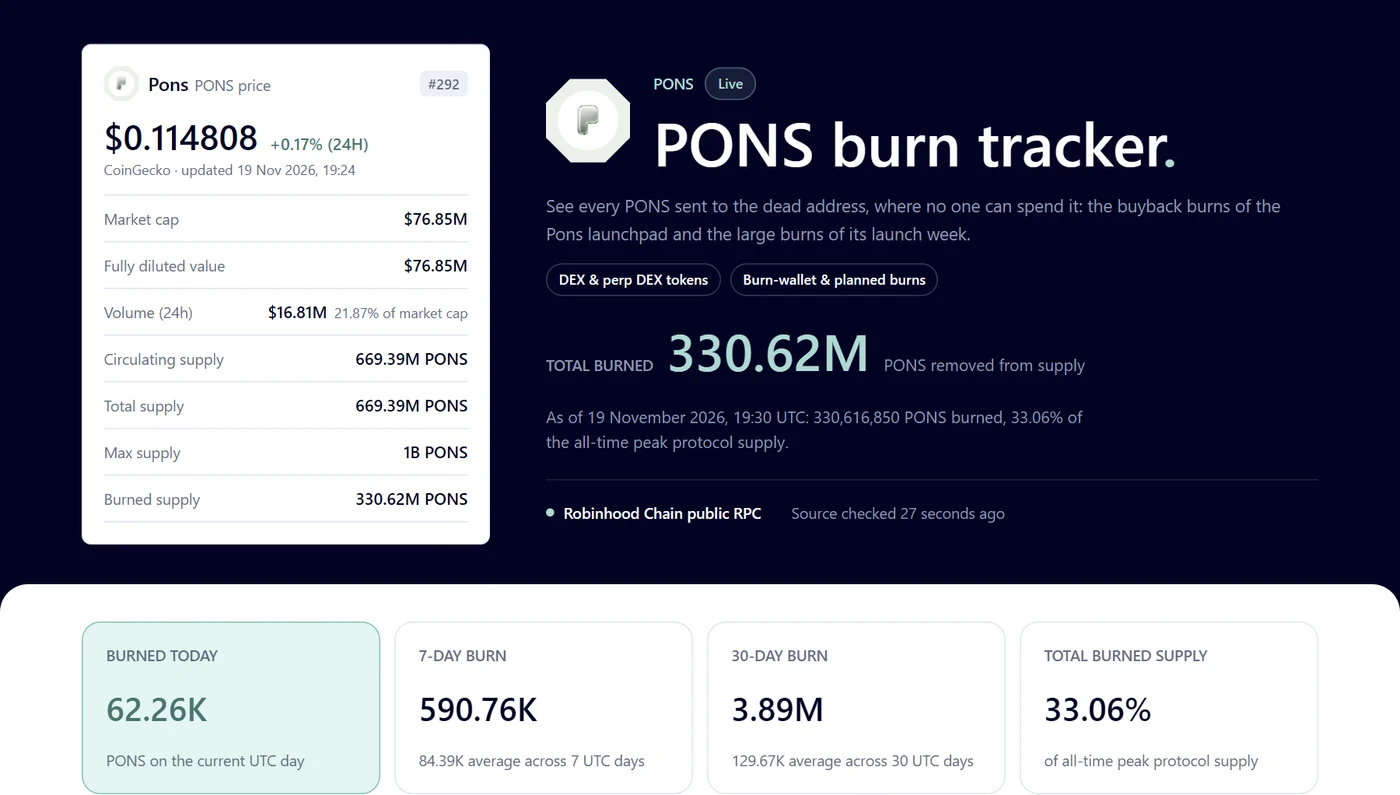
A third of all the PONS ever created is already gone, and the coin is only four months old. That sounds like a buyback working overtime. It isn’t quite: most of it went in the coin’s first week, sent by four wallets nobody has put a name to. Here’s what PONS is, what Robinhood has to do with it, and what the PONS burn tracker can and can’t tell you.
What is PONS?
PONS is a memecoin attached to Pons, a launchpad on Robinhood Chain: a site where anyone can create a crypto token and trade it straight away. “Memecoin” isn’t our label. The white paper Pons Labs published under the EU’s crypto rules says the PONS token “serves solely as a memecoin”, with no vote and no job inside the launchpad.
The coin was created on 13 July 2026 with a fixed supply of one billion. According to the white paper, a member of the community launched it on Pons, and the company adopted it afterwards. Pons Labs itself was registered in Delaware two days later.
What ties the PONS coin to the business is a buyback. The launchpad keeps a share of the trading fees its tokens generate, and says it spends 80% of that share buying PONS and burning it: sending it to a “dead” address nobody can spend from.
Is PONS Robinhood’s coin?
No. Robinhood Chain is Robinhood’s own blockchain network, and Robinhood’s documentation calls it permissionless: anyone can launch a token there without asking. PONS is one of those tokens.
Pons says on its own site that it isn’t affiliated with Robinhood Markets, and the Robinhood Chain documentation we read doesn’t mention Pons. Nothing we found says Robinhood issued PONS or backs it.
PONS runs on Robinhood’s network. That is the whole connection we can document.
How much PONS has been burned?
About 330 million, a third of the supply. The timing matters more than the amount.
Almost a fifth of all PONS went to the dead address in the coin’s first seven days. The first burn came nine minutes after the token was created. Half an hour in, one wallet sent exactly 39 million PONS at once, still the largest burn on record.
Four wallets sent nearly all of that week’s burns, and none of them carries a name. Our research found they got their PONS from trading contracts, which fits tokens bought on the market, but it didn’t trace who paid.
So “a third burned” isn’t four months of steady buybacks. More than half of it is one week, and we can’t tell whether that week was the fee buyback Pons describes.
Who is burning PONS now?
One of those four wallets kept going until 2 September. That morning a smart contract, a program on the chain, sent its first burn, and seventeen minutes later the wallet sent its last. The contract has been burning ever since, in small slices around the clock.
That looks like a buyback moved from someone’s wallet into a program, and Pons’s documentation does describe a stream of small automated purchases. But neither it nor the white paper names the wallet or the contract, so the match is our reading, not Pons’s word. And the contract accounts for only about a ninth of everything burned.
Is the PONS burn slowing down?
Yes, sharply. In August the tracker counted close to two million PONS a day. So far in November it’s about 110,000.
A shrinking buyback can have an innocent explanation: when a coin gets more expensive, the same money buys fewer tokens. That covers the summer, when PONS climbed from a few cents to a peak above 90 cents in early September. It doesn’t cover the autumn: the price is back near 12 cents, and the burn kept shrinking.
By our estimate, the PONS burned each day in September was worth more than half a million dollars at that day’s price. In November it’s under $20,000. If the buyback is the fixed share of fees Pons describes, the launchpad is earning far less than it did. We can’t check that share on the chain, so that’s a reading, not a finding.
At November’s pace, burning another 1% of the supply would take about three months.
Pons’s own documentation says burning doesn’t guarantee a higher price. This autumn the burned share kept rising while the price fell by more than four-fifths from its high.
What to watch next
- The daily burn. The last four full days came in near 80,000 PONS each. If Pons’s account is right, it follows trading on the launchpad.
- The 80% becoming fixed. Pons says the share isn’t locked in yet, and the contract can still be upgraded. The white paper lists an unchangeable buyback as a future step.
- Names for the addresses. If Pons says which wallets and which contract are its own, the first week stops being a mystery.
How we counted
The tracker adds up every transfer of PONS into the dead address since the token was created, whoever sent it, once the chain reports it as final. To the end of 18 November 2026 that is 330,554,741.81 PONS in 43,826 transfers, 33.06% of the 1,000,000,000 created; the 134 transfers of 13 to 19 July account for 195,424,997.62 PONS. PONS has no burn function, so burned PONS sits at a burn address and the token still reports a supply of one billion. The tracker stops if that figure changes.
Who launched the token and the 80% share are Pons Labs’s own statements; we can’t check them on the chain. Its white paper, notified on 23 September, counts 684,320,736 PONS in trading, a figure the tracker’s count of unburned PONS passed through that same day. Dollar figures are our estimates: a day’s PONS times CoinGecko’s price for that day, as the tracker stores it from 15 July on. They are not money anyone spent. The three months is ours too: 10 million PONS at November’s 110,000 a day. Nothing here is a price forecast.
Check it yourself
- Look at the burned pile. On Robinhood Chain’s explorer, open the holders of the PONS token. The address ending in dEaD is the burn address. Some security programs flag this explorer.
- Compare with the tracker. The PONS tracker lists every burn with its transaction, and its methodology says what counts.
- Read Pons’s own words. The white paper says what the token is; the documentation describes the buyback and gives the token’s address.
Every new burn, and the share of the supply that’s gone, is on the PONS burn tracker.
Informational only, not financial advice.Sources
- BurnTracker: the PONS tracker (total, daily totals, totals by sender) and its methodology, read on 19 November 2026. Prices: CoinGecko, in BurnTracker’s price history and its market snapshot of the same day ($0.1155).
- BurnTracker’s research record for PONS: every transfer of PONS into the dead address from the token’s creation to 16 November 2026, read from Robinhood Chain’s public node. The launch week’s senders and the handover of 2 September come from it.
- Pons Labs: the MiCA white paper for PONS, notified on 23 September 2026 and published on 22 October 2026 (what the token is, who launched it, the company, the 80% share). The paper states that no authority has approved it.
- Pons: its documentation (how a launch works, fees and burns, the token’s address) and the footer of ponsfamily.com (no affiliation with Robinhood Markets), read on 19 November 2026.
- Robinhood: About Robinhood Chain and Connecting to Robinhood Chain, read on 19 November 2026.
- Robinhood Chain’s public node, read on 19 November 2026: the dead address’s PONS balance and the contract’s total supply of 1,000,000,000 PONS.