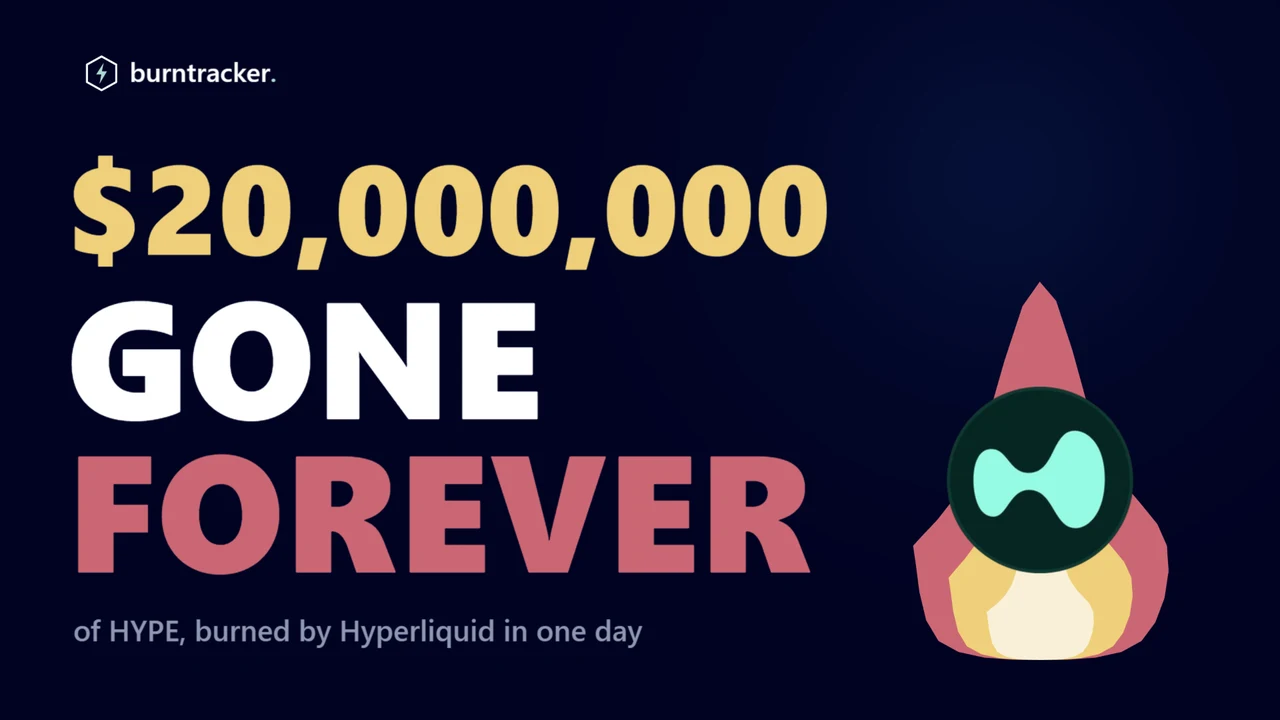
On 10 October 2025, crypto went through the biggest wave of forced selling the data firm CoinGlass has ever recorded. That same day, Hyperliquid burned about $20 million of its own token, HYPE: more than on any other day in the Hyperliquid burn tracker’s records. The two are connected, but not the way most people assume. The money traders lost didn’t buy that HYPE. Trading fees did, and most of them were spent inside three hours.
What happened on 10 October 2025
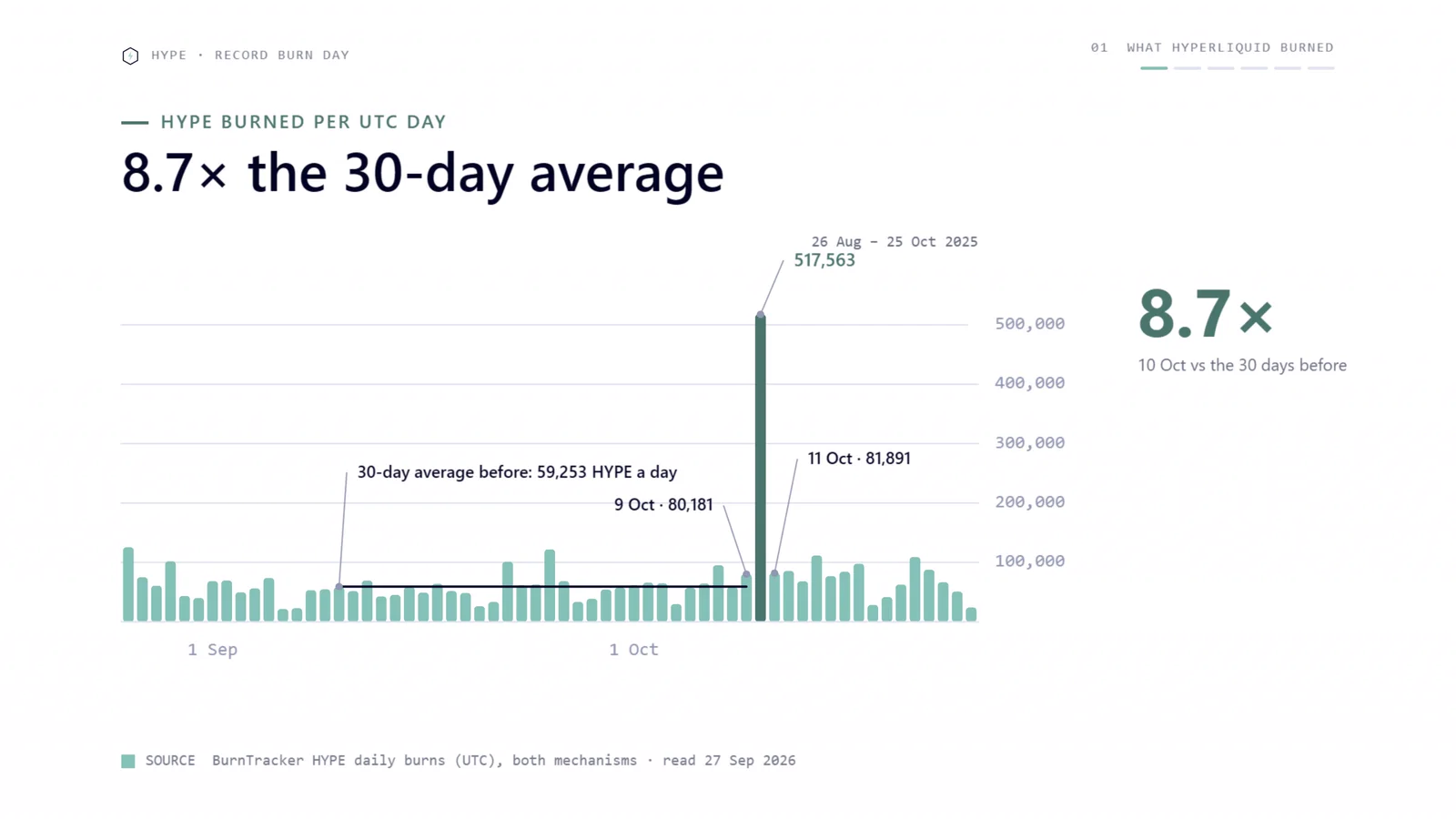
The HYPE burn is normally a steady trickle. In the month before, it ran at about 59,000 HYPE a day. On 10 October it came to about 518,000. That’s almost nine times the usual, and no other day in our records reaches much more than half of it.
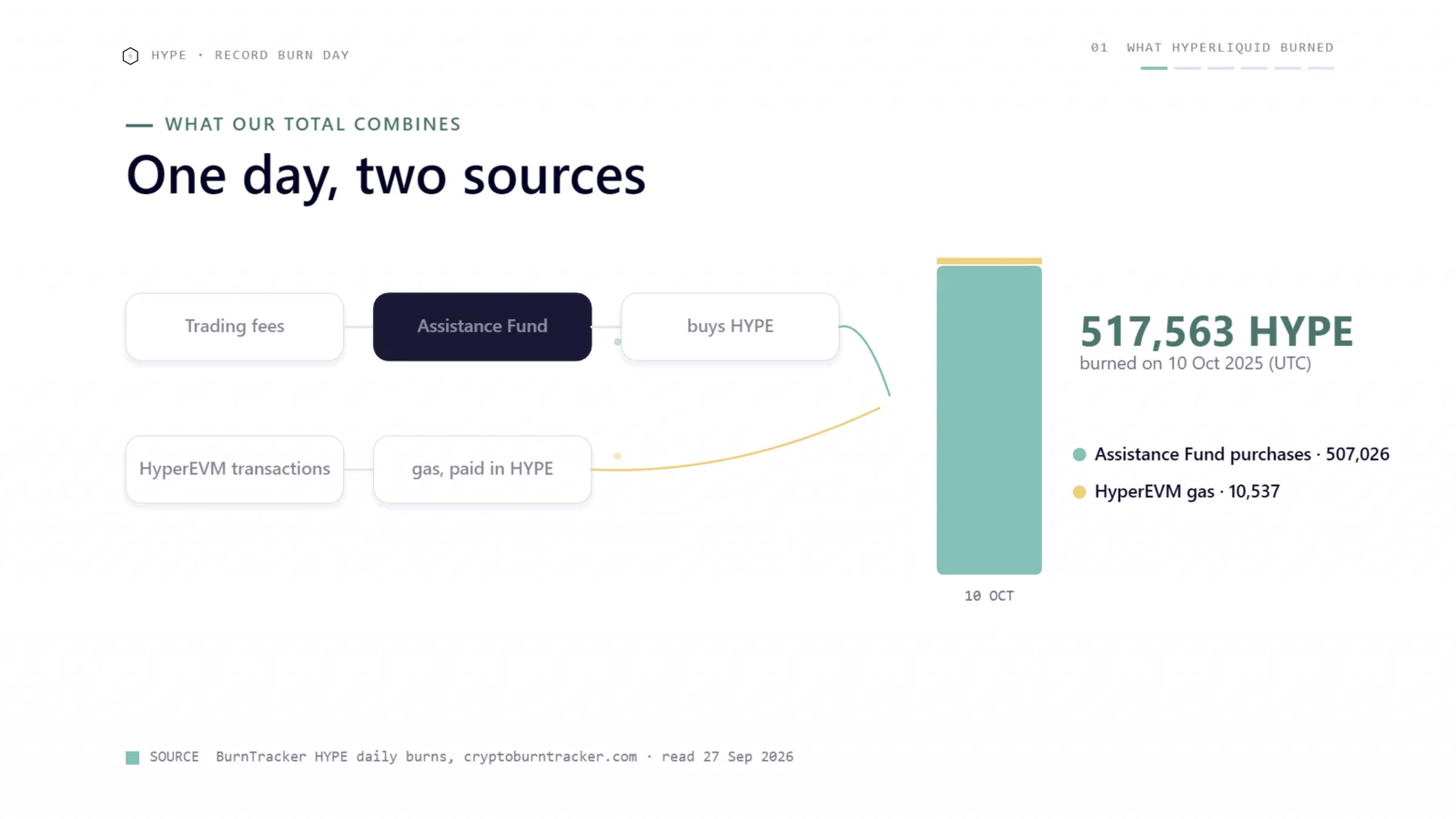
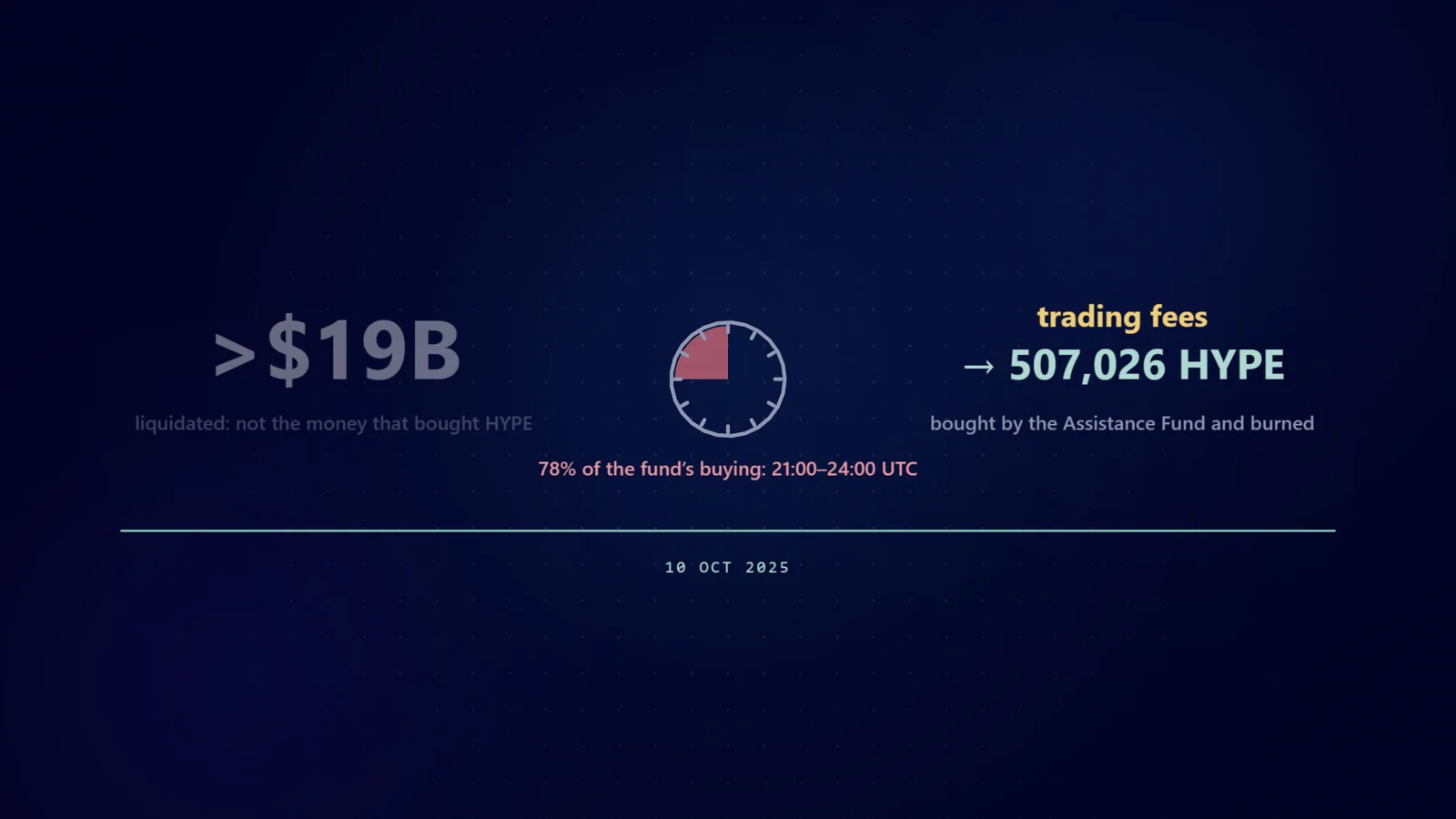
Nearly all of it came from Hyperliquid’s Assistance Fund, which turns the exchange’s trading fees into HYPE. It bought about 507,000 HYPE that day. It did so in almost 7,000 small purchases. The rest was gas burned on HyperEVM, Hyperliquid’s smart-contract chain.
Outside, the market was coming apart. CoinGlass counted more than $19 billion of leveraged positions closed by force that day, far above any earlier day in its data. Bloomberg, citing CoinGlass’s figures, reported that Hyperliquid liquidations alone came to more than $10 billion of that.
How does a crash turn into trading fees?
Through leverage. Follow one trade.
You put in $1,000 and open a $10,000 position, betting that a coin will rise. A 10% fall would wipe out your money, but the exchange doesn’t wait that long. On Hyperliquid, for a coin that allows up to 40x leverage, the position is closed for you after a fall of just under 9%.
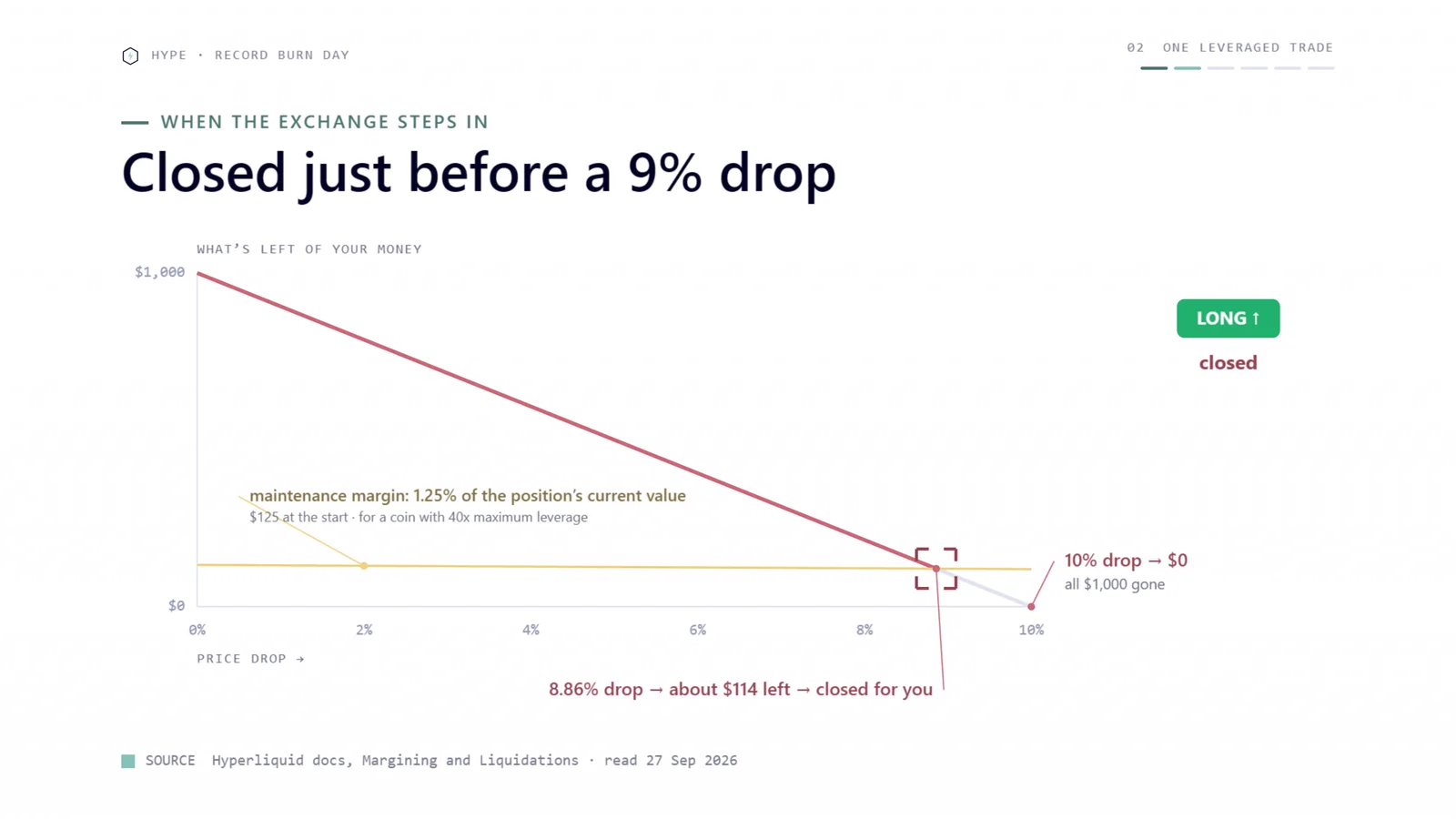
That forced close is a liquidation, and a liquidation is a sale. Hyperliquid’s docs say it first tries to close the position with market orders, which for a bet on rising prices means selling. Selling pushes the price lower, and the lower price trips the next trader’s limit. That’s a liquidation cascade.
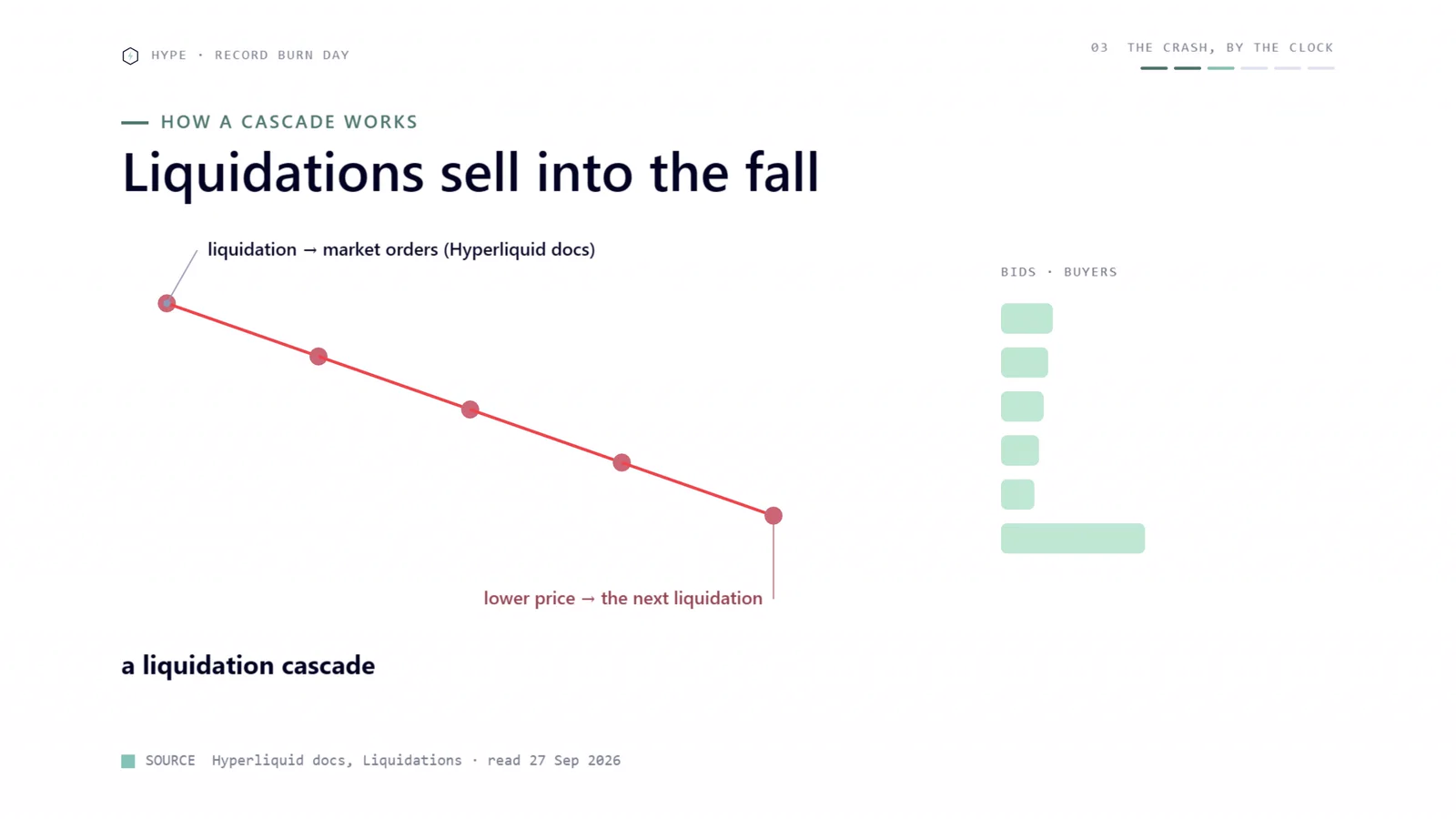
A cascade is a day of frantic trading: forced sales, panic sales, people buying the dip. Hyperliquid charges no special fee for being liquidated, but it charges its ordinary fee on trades, and on a day like that there are far more of them.
How do Hyperliquid fees become burned HYPE?
Automatically. Hyperliquid’s docs name three places its fees go: the Assistance Fund, a protocol-run vault called HLP, and the teams that launch some markets. They don’t give the split. DefiLlama estimates that about 99% of Hyperliquid’s own fees reach the fund.
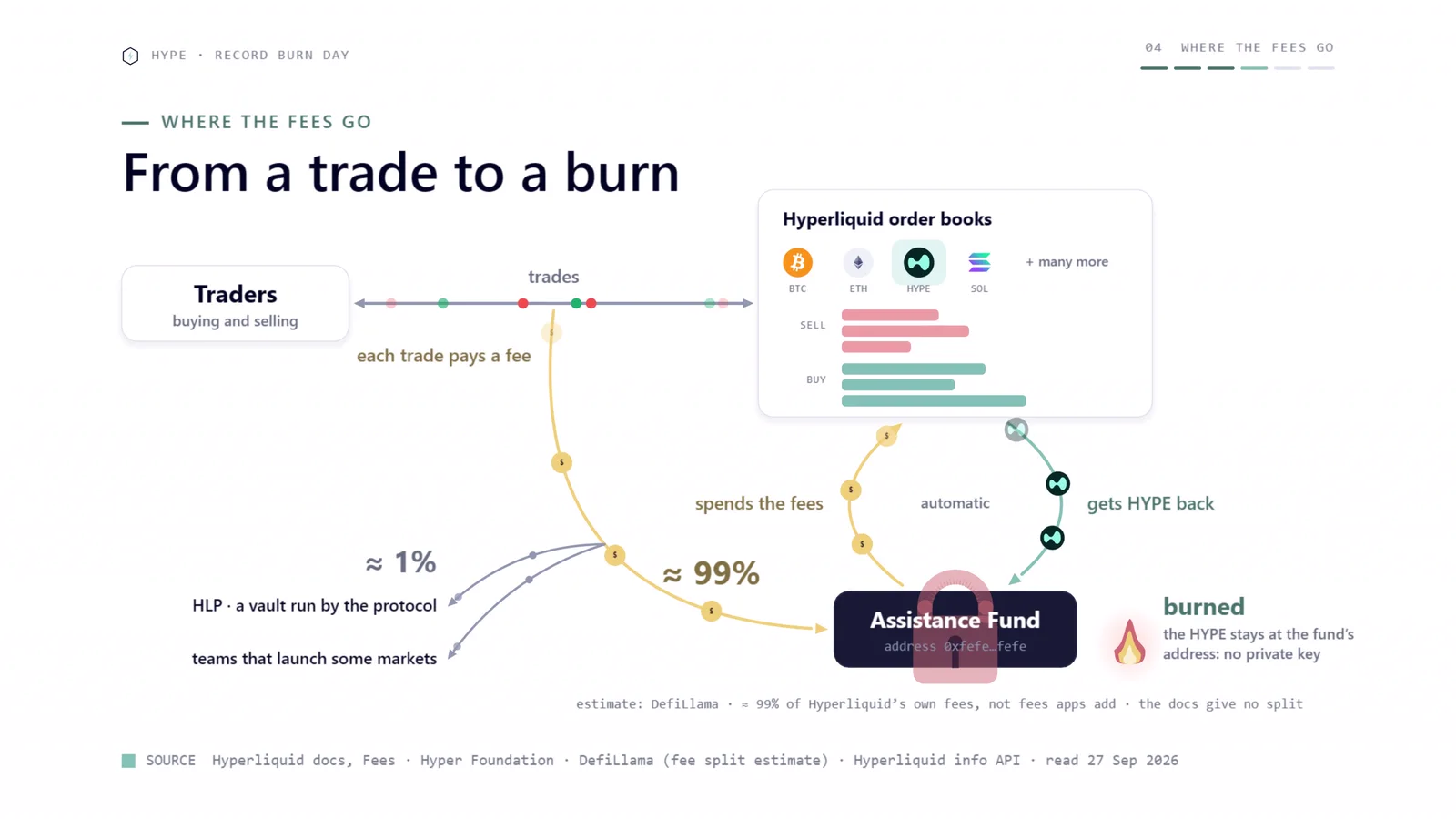
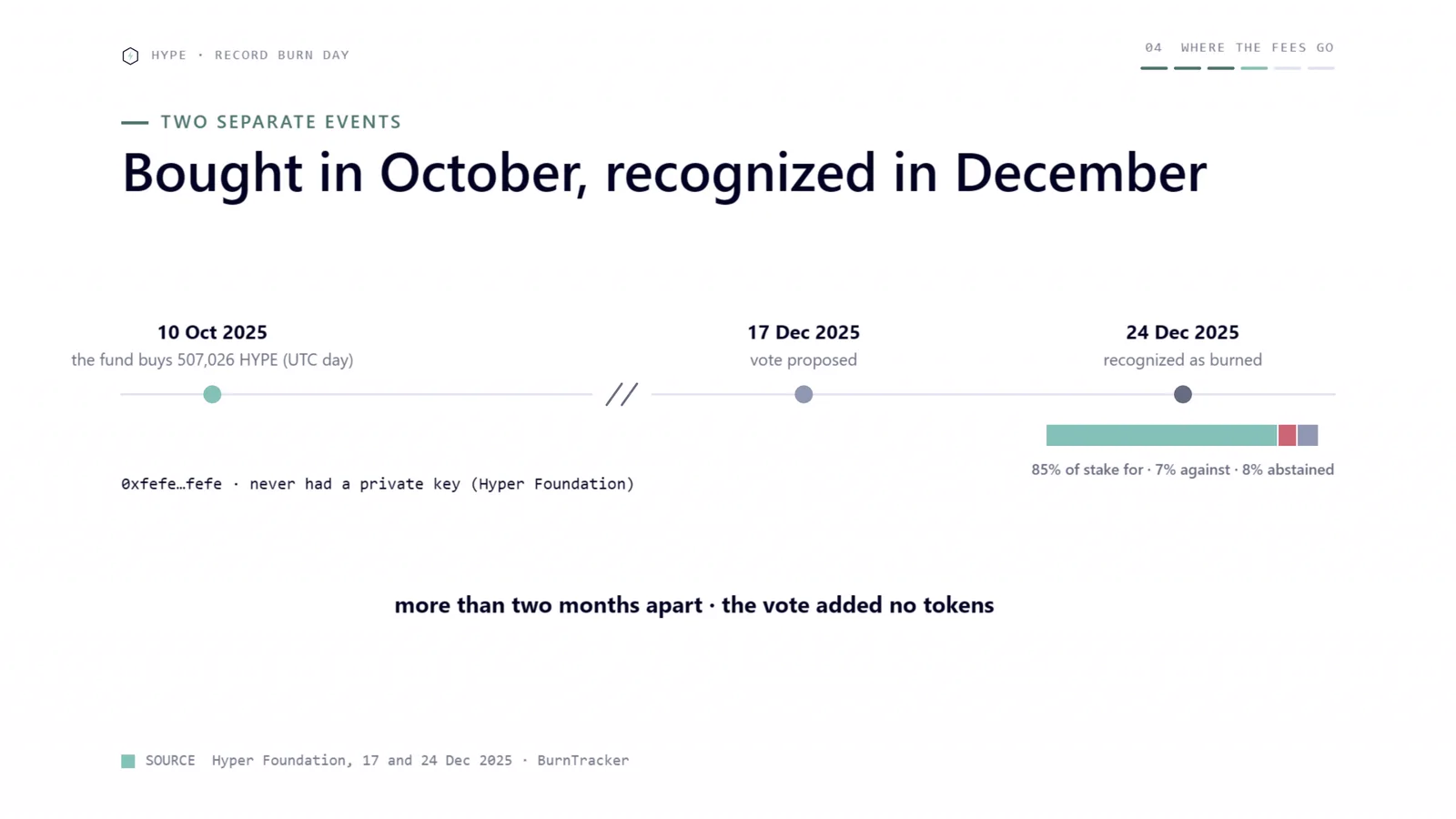
The Hyperliquid Assistance Fund then buys HYPE on Hyperliquid’s own order book. Nobody places those orders; the buying is built into the chain. And the HYPE never leaves, because the fund’s address has no private key. That’s why the docs count it as burned, and why a validator vote in December 2025 could make it official without moving a token.
When did the fund buy?
Almost all of it in the last three hours of the day. BurnTracker keeps the time of every purchase, so the day can be replayed hour by hour. Until the evening, the fund bought a few thousand HYPE an hour. At nine in the evening UTC, its buying exploded.
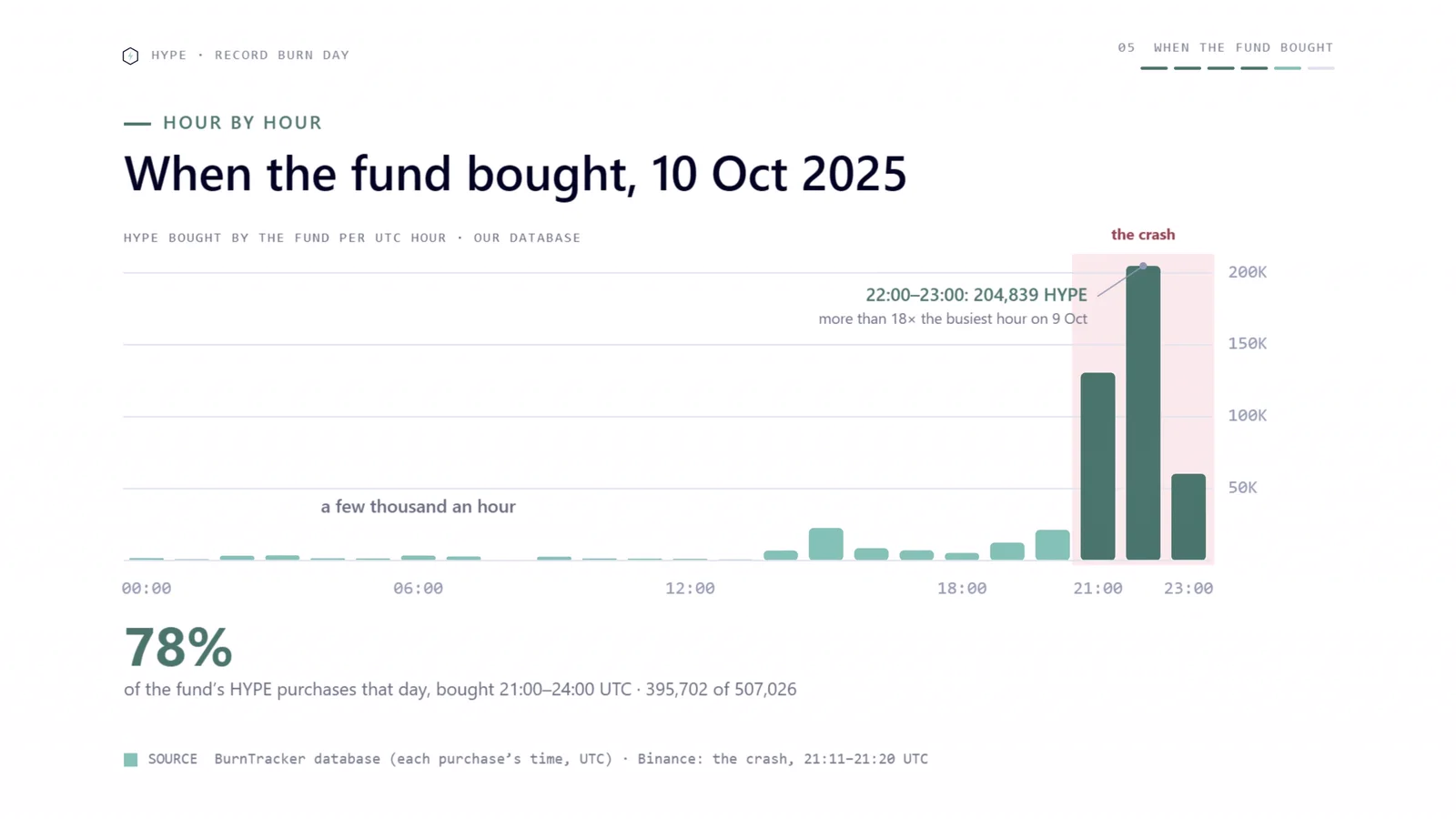
Between nine and midnight it bought about 396,000 HYPE. That’s 78% of everything it bought that day.
The record burn wasn’t spread across the day. Most of it happened inside the crash.
Those were the hours when prices gave way: on Hyperliquid’s own market, HYPE fell by about a fifth at its lowest in the last four hours of the day. That helps the burn twice. More fee money comes in, and each dollar buys more HYPE.
Did that day’s fees pay for all of it?
No, and this is where the tidy story has a gap. DefiLlama counts about $8.8 million of fees reaching the fund that day, the most on its record. The HYPE the fund bought cost about $20 million, by our estimate.
If both figures are right, more than half of the money came from somewhere else, most likely fees collected on earlier days and not yet spent. We can’t confirm that. Our records show when the fund bought and how much, not which day’s fees paid for which purchase.
What does this mean if you hold HYPE?
First, the Hyperliquid burn is a meter, not a schedule. It runs fastest when trading is most frantic, and trading is rarely more frantic than in a sell-off. The next two biggest days were 7 and 9 April 2025, in the week a tariff sell-off shook crypto. If you’re hoping for another record burn, you’re hoping for a day most holders won’t enjoy.
Hyperliquid’s burn follows trading. Its biggest day was crypto’s biggest day of liquidations.
Second, even a record is small next to the supply: that day removed about 0.05% of all the HYPE ever created.
Third, the pattern is changing. Since late August 2026 the fund has had a second income: a share of the interest on the dollars held on Hyperliquid, paid every 30 days. Bankless reported the plan when validators approved it, with the first payment due on 3 October. The tracker shows the fund buying far more than usual right after that date, and again on 3 November, the fourth-biggest burn day in our data. HYPE’s price ended that day about where it began.
We can’t trace the money, so that’s our reading of the calendar, not something Hyperliquid has confirmed. If it’s right, a big burn day no longer has to be a bad day.
What to watch next
- The next violent day. If the pattern holds, the burn jumps while the sell-off is still running.
- The first days of December. If the 30-day payments are what we think they are, the next one lands then, whatever the market does.
- The everyday level. Over the last 30 days the burn averaged about 36,000 HYPE a day. The record day was two weeks of that in one.
How we counted
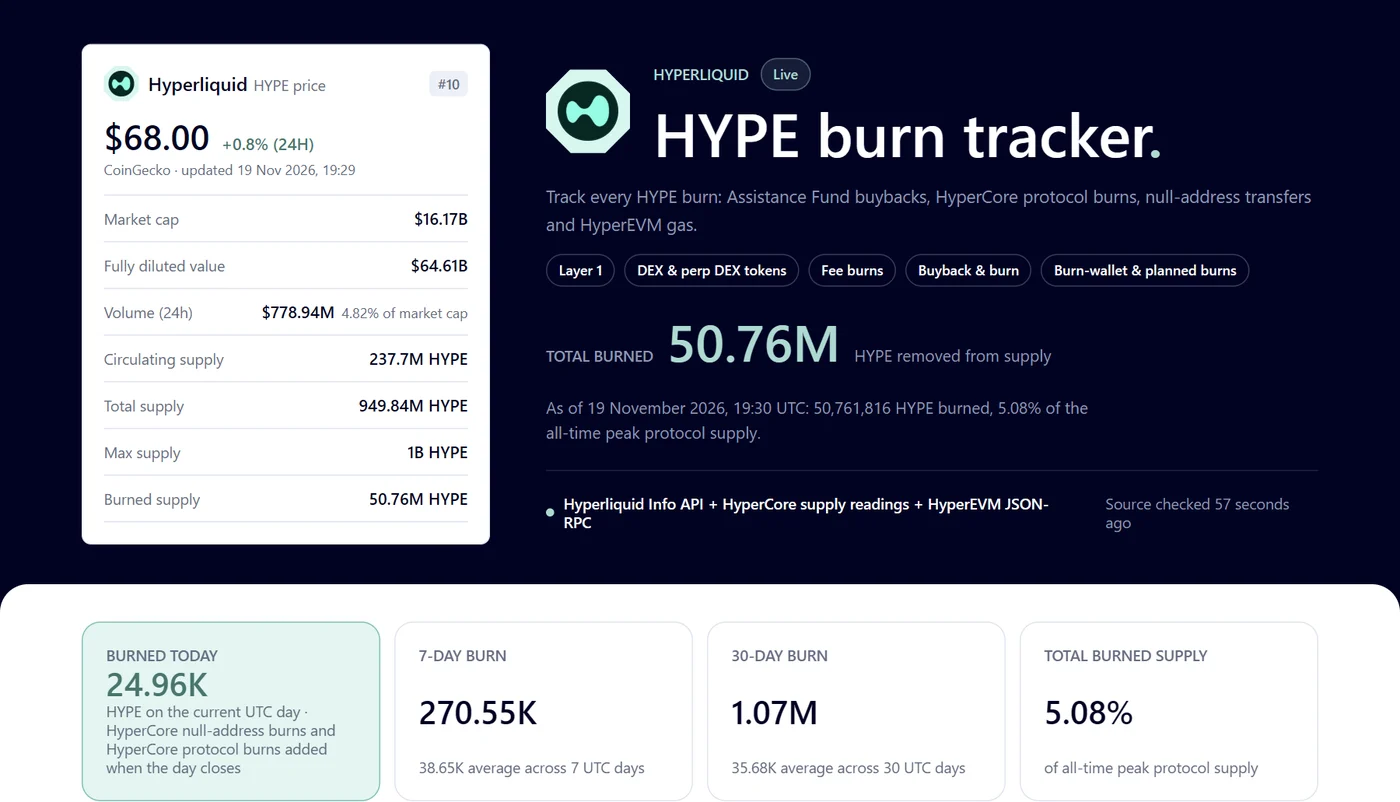
The day’s total is two lines of the tracker, by UTC day: 507,026 HYPE bought by the Assistance Fund in 6,853 purchases and 10,537 HYPE of HyperEVM gas, 517,563 in all. “Record” means the biggest day in our daily data, ahead of 287,696 HYPE on 7 April 2025. That data starts on 22 March 2025 for the fund; what it bought earlier is one opening balance, so earlier days can’t be ranked. HyperCore’s protocol burns have no daily record before October 2026 and aren’t in that day.
Our database stores the time and size of each purchase, not its price, so the dollar figure is our estimate. Pricing each four-hour block of purchases at the lowest and at the highest price HYPE traded for on Hyperliquid’s own market gives $18.2 million to $22.1 million, so we say about $20 million. It isn’t what that HYPE would be worth today.
CoinGlass’s total is the size of the positions closed, not money lost. DefiLlama’s figure comes from its own model of Hyperliquid’s fees. Nothing here is a price forecast.
Check it yourself
- Find the day. On the HYPE tracker, set the daily burn chart to “All” and look for the spike on 10 October 2025.
- Look at the fund. Its address, 0xfefefefe…fefefefe, is public on Hyperliquid’s explorer. Every purchase is a trade listed there, and nothing has ever been sent out.
- Read the rules. Hyperliquid’s docs on fees say where fees go and that the fund’s HYPE is burned. The tracker’s methodology says what we count.
The next sell-off will show up on the Hyperliquid burn tracker the day it happens. So will the next quiet week.
Informational only, not financial advice.Sources
- BurnTracker: the HYPE tracker (total, daily totals and purchase counts) and its methodology, read on 19 November 2026. The fund’s purchases per hour on 10 October 2025 are from BurnTracker’s database, read on 27 September 2026 for our video on the same day. HYPE’s price on 3 November 2026: CoinGecko, in BurnTracker’s market history.
- Hyperliquid’s docs: Fees (where fees go, the Assistance Fund, its HYPE counted as burned), Liquidations, Margining, Protocol vaults (HLP) and HyperEVM (gas is burned), read on 27 September 2026.
- Hyperliquid’s public API, api.hyperliquid.xyz/info: HYPE’s prices on Hyperliquid’s own spot market on 10 October 2025, in four-hour blocks, read on 19 November 2026. The Assistance Fund’s address on Hyperliquid’s explorer.
- The vote: the Hyper Foundation’s proposal (17 December 2025) and result (24 December 2025).
- Liquidations: CoinGlass, 2025 Crypto Derivatives Market Annual Report, read on 19 November 2026. By exchange: Bloomberg’s crypto newsletter of 14 October 2025, citing CoinGlass data.
- Fees: DefiLlama, Hyperliquid: its estimate of the share of fees that reaches the fund, and its figure for 10 October 2025, read on 19 November 2026.
- The interest payments to the fund: Bankless, Hyperliquid Passes AQA v2 to Fund More HYPE Buybacks, 12 June 2026; Crypto Briefing, Hyperliquid lines up roughly $15M in USDC yield for HYPE buybacks, 3 October 2026.
- April 2025: Decrypt, Bitcoin Price Breaks Below $75,000 as Global Tariff War Roils Risk Assets, 7 April 2025.