On 28 August 2025, more ICP was burned in one day than in all of 2022. It looked as if the Internet Computer had never been busier. It hadn’t: almost all of it was ICP created for a token sale, destroyed in eleven minutes when the sale was undone. It’s the best way into the question the ICP burn tracker raises most: does the burn shrink ICP’s supply? Not yet, and not nearly.
What does ICP burn, and why?
Almost all of it is ICP spent on computing. Apps on the Internet Computer pay for processing and storage in units called cycles. To get cycles, you hand ICP to a system canister, which destroys it and credits cycles at the going rate. By our count, about 97% of all ICP ever burned went this way. The ledger also destroys a tiny fee on every transfer, which barely registers.
So this isn’t a buyback, and nobody sets the amount: the burn is the network’s computing bill, paid in ICP. And because cycles have a fixed price in a basket of major currencies, cheaper ICP means more ICP burned for the same computing.
What happened on 28 August 2025?
A token sale was undone, and the ICP created for it was destroyed. One account began receiving ICP in lots of 5,000 and burned each lot as it arrived: twenty burns in eleven minutes, about 88,000 ICP.
The trail runs back six months. In February 2025 a project called FuelEV sold tokens on the Internet Computer and took in about 205,000 ICP. Buyers put in a little over half. The rest came from the network’s Neurons’ Fund, which adds matching ICP to such sales, and the ledger shows that share arriving as newly created ICP.
Then the sale was unwound. Over the summer FuelEV’s treasury paid everything out to one wallet, which sent the buyers their ICP back. What it had left on 28 August matched the fund’s share to within a hundredth of an ICP, and that is what was burned. We found no public statement from the team, but the Internet Computer’s own dashboard still lists the sale, and the canisters that ran the project no longer exist.
So this wasn’t a payment for computing, and it didn’t really shrink ICP’s supply either: it cancelled ICP created half a year earlier. Without those eleven minutes, 28 August was an ordinary day of about 1,300 ICP.
ICP’s biggest burn day says nothing about how busy the network was. It undid a mint.
What is ICP’s burn rate now?
About 1,700 ICP a day, going by the last 30 days on the tracker. Kept up for a year, that’s a little over a tenth of one percent of the supply.
Even that flatters the typical day: half of all days in the past year came in under about 700 ICP. A few huge days pull the average up, and seven of the ten biggest in the chart above come from one buyer of cycles.
Over the first nine months of 2026, that buyer was more than half of all ICP burned. From June to September it bought almost nothing.
So the “ICP burn rate” is less the pulse of thousands of apps than the computing bill of a few big customers. When one changes plans, the whole number moves.
How has the burn changed over time?
It came as one wave. For more than three years after launch, ICP burned about 140 ICP a day. Then, in September 2024, the monthly total jumped fifty-fold.
The wave peaked in early 2025 at more than 280,000 ICP a month, then drained away: this year’s daily average is less than half of last year’s.
Like the big days, the wave was narrow. About half of the ICP burned in its twelve strongest months went to top up a single canister.
So a higher burn means someone is paying for more computing. It doesn’t have to mean that many are.
Is ICP deflationary?
No. ICP’s supply has grown in every month of our record, from launch to September 2026.
The network also creates new ICP, to reward people who lock up ICP and vote, and to pay the companies that run its machines. In the twelve months to September 2026, about 28 new ICP were created for every one burned.
Even in the burn’s best month, February 2025, new ICP outran it by more than three to one. DFINITY, the foundation behind ICP, agrees: its February 2026 paper says minting is “only partially offset by burning through cycles” and aims to cut ICP’s inflation by at least 70% by the end of the year. Lower inflation is still inflation.
A burn total tells you what left. Whether ICP’s supply shrinks depends on what comes in, and for now that is far bigger.
What to watch next
- New ICP per month. It’s the bigger lever by far. In our replay of the ledger it halved between January and September 2026; whether that’s DFINITY’s proposed reward cuts or holders leaving rewards unclaimed, the ledger doesn’t say.
- The 30-day burn on the tracker. To cancel out September’s new ICP, it would have had to be about fifteen times higher.
- Who is behind the next big day. One buyer’s bulk order, or one unwound sale, isn’t the network getting busier.
How we counted
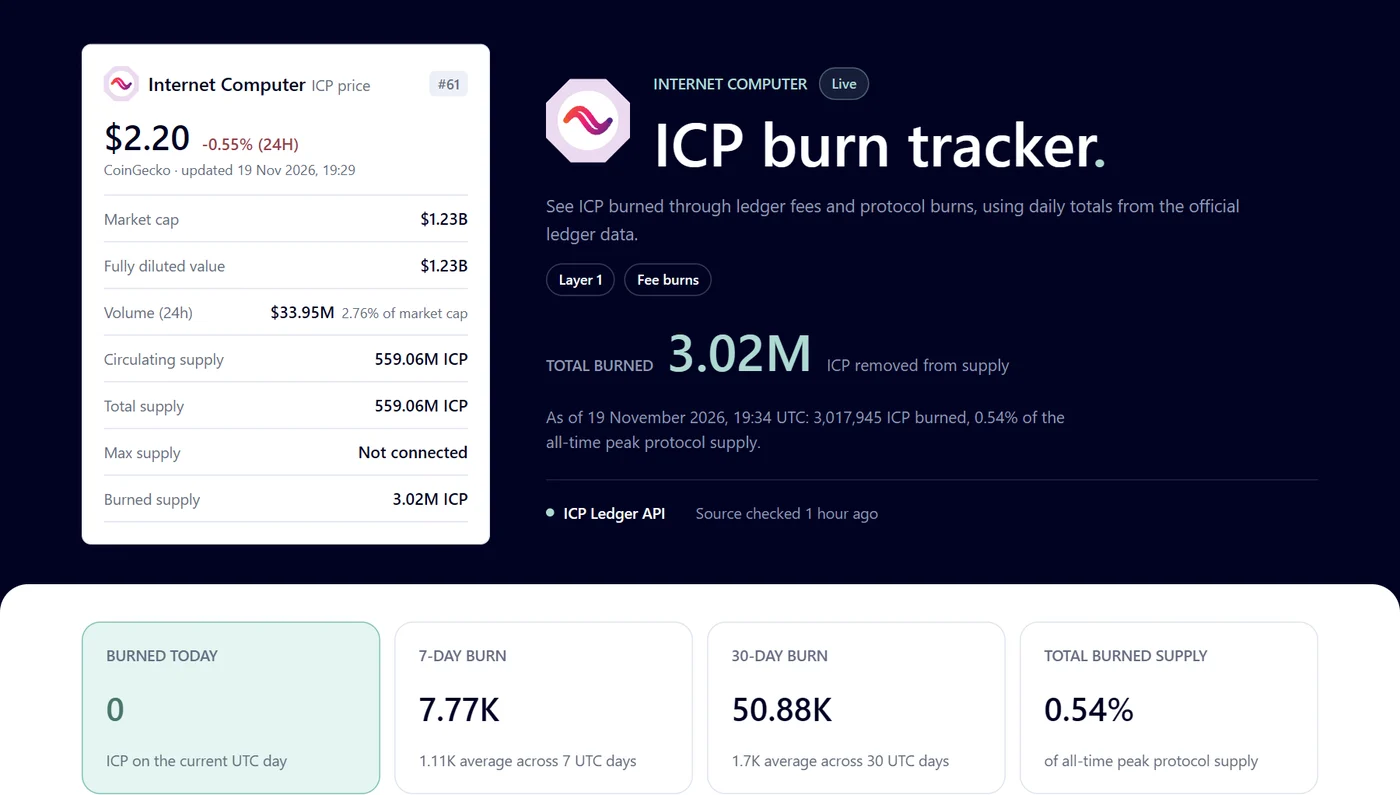
The tracker reads the ICP ledger’s two running totals of burned ICP and publishes the change for each UTC day: 3,017,944.99 ICP to 18 November 2026, 3,922.01 of it transfer fees. The record day is 89,470.84 ICP, the last 30 days average 1,737 ICP a day, and the median day of the past year is 718 ICP.
Daily totals can’t show who burned. For that, and for new ICP, we replayed every block of the ledger to 30 September 2026. On the record day one account made 20 burns worth 88,169.80 ICP; the mint for FuelEV’s sale, on 14 February 2025, was 88,169.69 ICP. Burns from accounts paid by a transfer marked for the cycles canister come to 2,847,683 of 2,937,321 ICP. From October 2025 to September 2026 the ledger minted 19,234,579 ICP and burned 678,618.
A year at 1,737 ICP a day is about 634,000 ICP, or 0.11% of the 557 million in existence; that estimate is ours. At today’s $2.20, everything burned since 2021 comes to about $6.6 million: a count times a price, not money spent. Nothing here is a price forecast.
Check it yourself
- Find the day. On the ICP burn tracker, set the daily burns chart to “All”: 28 August 2025 is the spike.
- Open the account. The ICP dashboard’s page for account 86cb75be…5df17b lists 20 transfers in and 23 burns, the last in ledger block 27,327,963. The mint it cancelled is block 20,462,809.
- Read the rules. The tracker’s methodology says what its two burn lines count.
Today’s burn and every day since May 2021 are on the ICP burn tracker. When the next spike comes, ask who before you ask how much.
Informational only, not financial advice.Sources
- BurnTracker: the ICP tracker (the total, the two burn lines and their daily totals from 7 May 2021) and its methodology, read on 19 November 2026. Price: CoinGecko, in BurnTracker’s market snapshot of the same day ($2.20).
- BurnTracker’s research record for ICP: a replay of every block of the ICP ledger from block 0 to 30 September 2026, read on 1 October 2026 from the ledger canister ryjl3-tyaaa-aaaaa-aaaba-cai and its archives. From it come the accounts behind the largest burn days, the path of the FuelEV sale’s ICP from mint to burn, the split between conversions into cycles and other burns, the ICP created each month and the supply at the end of each month.
- The ledger’s rules: DFINITY’s ICP ledger source (a transfer to the minting account is a burn; the transfer fee is 0.0001 ICP, which is also the smallest burn) and the cycles minting canister source (the codes CREA, TPUP and MINT).
- DFINITY documentation: System canisters (the cycles minting canister turns ICP into cycles by burning it; one trillion cycles per XDR).
- DFINITY Foundation: Dominic Williams and Björn Assmann, Mission 70 and Accelerating the Internet Computer Economy, version 1.1.1, 6 February 2026 (the two channels of new ICP, the quoted sentence, the 70% target and how rewards become ICP).
- The unwound sale: the ICP dashboard’s page for FuelEV, opened on 19 November 2026 (372 buyers, the Neurons’ Fund’s share, and governance and ledger canisters that no longer run; its figures match our reading of the ledger), and DFINITY’s documentation of the SNS framework (matched funding from the Neurons’ Fund; the ICP collected becomes the treasury).
- Reports of the record day: Ledgerlife, ICP Sees Record Daily Token Burn of 89,468 ICP Amid Rising Network Use, 30 August 2025, which read it as rising network use; ICPulse, The ICP burned to cycles on a busy day is mostly one standing order, Internet Computer developer forum, 9 August 2026, on single buyers behind busy days.