In June 2018, TRON burned a billion TRX in a single day and called it Independence Day. It’s still the biggest single burn on the TRX burn tracker. But it’s the small part of the story. Ordinary network fees have since burned about 17 times as much, a few TRX at a time. And here’s the odd part: as of 19 November 2026, TRX’s supply is growing again.
What was the Independence Day burn?
A one-off, done to celebrate a launch. Until June 2018, TRX was a token on Ethereum. On 25 June it moved to TRON’s own blockchain, and the TRON Foundation burned a billion TRX “to commemorate this exciting moment”, as its announcement put it.
That was 1% of all the TRX in existence. It came out of the Foundation’s own holdings, not out of anyone’s wallet, and it’s why TRON’s chain started life with 99 billion TRX.
Nothing in how TRON works repeats it. What mattered far more arrived with the new chain: a rule that destroys fees.
How does TRON burn TRX today?
Through fees, automatically, in every block. A TRON transaction uses up two resources, called bandwidth and energy. You can get them by staking TRX, which costs nothing but ties up your coins. If you don’t have enough, you pay the difference in TRX, and that TRX is destroyed.
Nobody announces these burns. They just add up.
It started slowly: fees took until the summer of 2021 to burn as much as that one day in 2018. Then the pace picked up. In 2023 alone, the network burned about five and a half billion TRX.
The Independence Day burn was a billion TRX, once. In 2023, fees burned that much about every two months.
That single burn is now less than 6% of the tracker’s total.
Why has the TRX burn fallen since 2023?
Mostly because of votes. The price of energy isn’t set by a market. It’s set by TRON’s 27 Super Representatives, the elected accounts that produce its blocks, and when they change it the burn moves within days.
On the way up, they doubled the price in October 2021 and raised it again in December 2022. The 2021 proposal said what it was for: to make TRX deflationary. In February 2023 a new rule made the busiest contracts pay extra, and a day later the daily burn had roughly doubled.
On the way down, more users staked TRX for their energy instead of paying for it, and in 2024 the network doubled the energy that stakers share. Then the Super Representatives cut the price twice. The second cut, in August 2025, is the drop marked on the chart.
The reason was cost. By 2025 TRX’s own price had about doubled, which made every transfer dearer in dollars. The 2025 proposal said openly that the cut could tip the supply from shrinking to growing, and hoped new activity would make up for it.
So far it hasn’t. In October 2026 the network burned about 75 million TRX. Its best month, in early 2023, saw more than seven times that.
Is TRON deflationary?
Not right now, though for a long stretch it was.
A burn total only counts what left. TRON also creates new TRX in every block, as rewards for the Super Representatives and the people who vote for them. The supply shrinks only while the burn is bigger than those rewards.
Until late 2021 it wasn’t, and the supply grew to a peak of about 102 billion TRX. The day after that peak, the doubled energy price took effect. The burn overtook the rewards, and the supply fell for almost four years. It’s around 95 billion today.
The 2025 fee cut reversed that. A fee review posted in TRON’s governance repository in October says the supply has grown in every month since November 2025. Our own arithmetic agrees. The rewards add about 3.9 million new TRX a day. Over the last month, the tracker has seen about 2.5 million a day burned.
There are about 7 billion fewer TRX than at the 2021 peak. But the supply isn’t shrinking any more. It’s growing again, slowly.
For a holder, that puts the tracker’s 18 billion in its place. Those TRX are gone for good. But the total describes the past. Where the supply goes next depends on the fee and the reward, and the same Super Representatives vote on both.
What to watch next
- The next fee vote. Fees are now reviewed every quarter, and the latest review argues against cutting further until the burn recovers. If the energy price goes up instead, expect the burn to jump within days, as it did in 2021.
- A cut in rewards. They were last reduced in June 2025, and the author of the 2025 fee-cut proposal has asked whether to reduce them again. Fewer new TRX would close the gap from the other side.
- The daily burn itself. It’s on the tracker every day. By our arithmetic, it has to climb back above roughly 3.9 million TRX a day before the supply shrinks again.
How we counted
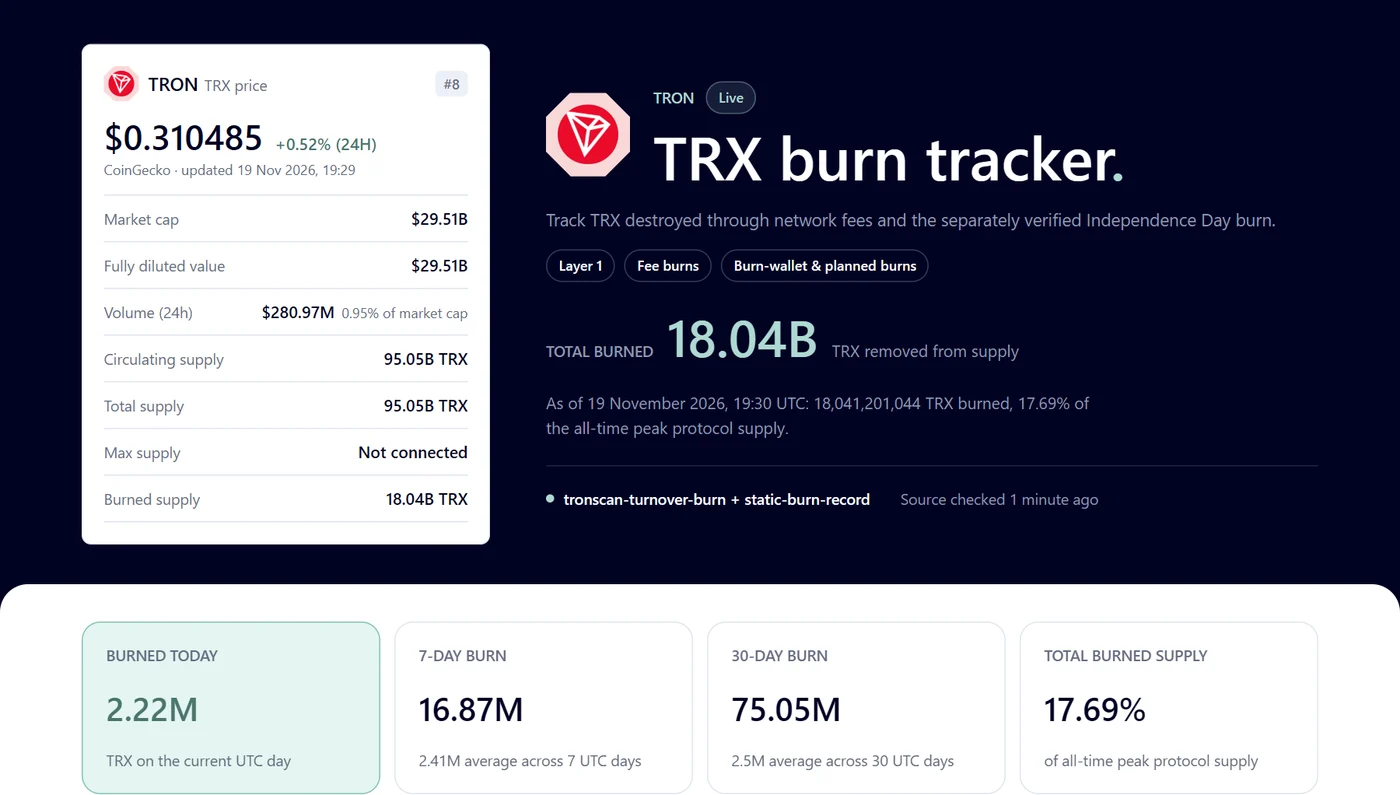
The tracker’s TRX total has two parts. The Independence Day burn is one record of exactly 1,000,000,000 TRX, dated 25 June 2018, with no transaction on TRON’s chain to show for it. Fee burns came to 17,038,986,233 TRX by 18 November 2026, the last complete day. That makes 18,038,986,233 TRX in all.
Daily figures begin on 29 December 2019. Earlier fees are one opening balance of 130,235,154 TRX, shown in the first chart’s bar for 2018 to 2020. Daily totals before 29 September 2026, and for 27 October to 13 November 2026, are TRONSCAN’s; the rest are read from the chain, block by block.
The supply figures aren’t the tracker’s own. The peak, 101,985,293,225 TRX on 27 October 2021, is the baseline behind its burn share, and today’s 95,047,295,638 TRX is CoinGecko’s. New TRX is our estimate: 136 TRX of rewards per block, from TRON’s documentation, times the 28,792 blocks the tracker reads in a full day.
At today’s price of about $0.31, the 18 billion TRX would come to roughly $5.6 billion. That’s a count times a price, not money anyone spent. Nothing here is a price forecast.
Check it yourself
- Match the votes to the burn. TRON’s list of proposals on GitHub gives the day each one took effect: 71 and 79 raised the energy price, 95 and 104 cut it, and 102 cut the rewards. Compare those days with the burn history on the TRX tracker, whose methodology says what counts.
- Read TRON’s own count. The fee review for the third quarter of 2026 compares new TRX with burned TRX, month by month.
If the Super Representatives turn the dial again, the daily burn on the TRON burn tracker is where it will show.
Informational only, not financial advice.Sources
- BurnTracker: the TRX tracker (both parts of the total, and daily totals from 29 December 2019 to 18 November 2026) and its methodology, read on 19 November 2026. Price and current supply: CoinGecko, in BurnTracker’s market snapshot of the same day ($0.3102; 95,047,295,638 TRX). Peak supply: the tracker’s baseline for 27 October 2021.
- The 2018 burn: The Daily Hodl, Tron Will Burn 1 Billion Coins to Celebrate Its Independence From Ethereum, 21 June 2018, which quotes the TRON Foundation’s announcement; Finance Magnates, TRON Burns $50 Million in TRX to Celebrate Its Own ‘Independence Day’, 26 June 2018. The 99 billion TRX at launch: java-tron’s config.conf, where the genesis block credits 99000000000000000 millionths of a TRX to one account.
- The votes: TRON’s governance repository on GitHub. List of proposals with the day each took effect; the proposals to raise the energy price in October 2021 and December 2022, the rule for the busiest contracts, the cuts of September 2024 and August 2025, and the reward cut of June 2025.
- Whether the supply is growing: TRON Quarterly Transaction Fees Review, Q3 2026, opened on 21 October 2026, and the comments under it. We use what it concludes, not its figures.
- TRON developer documentation: Resource Model (bandwidth, energy, staking, and the TRX burned when they run short) and Super Representatives (27 block producers; 8 TRX and 128 TRX of rewards per block).
- BurnTracker’s research record for TRX, reviews of 26 and 29 September 2026: the opening balance and how the tracker’s sources fit together. TRONSCAN’s TRX supply chart is the source of the tracker’s Independence Day record, of its peak supply and of the daily totals named above.