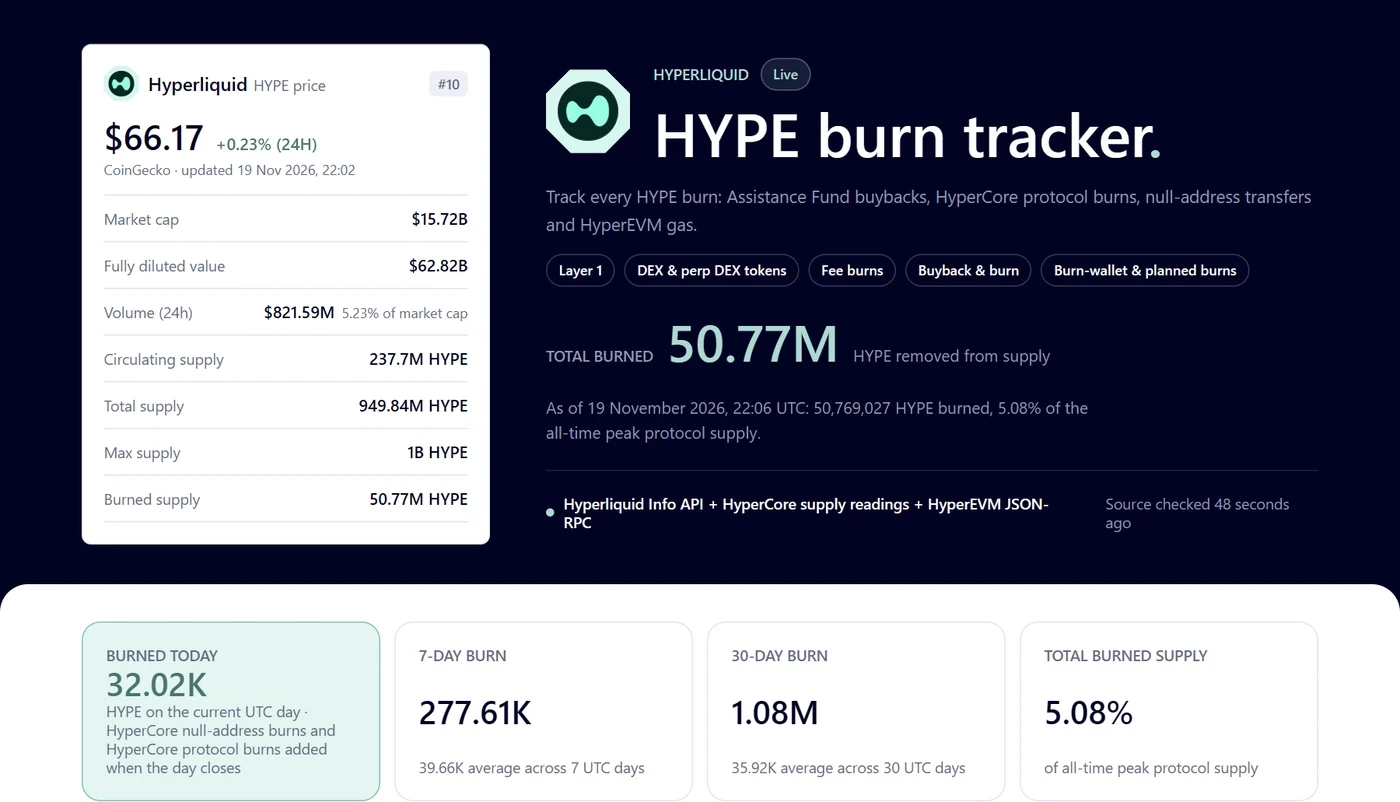
Most crypto burns destroy tokens; Hyperliquid’s biggest one keeps them. Its trading fees flow to an address called the Assistance Fund, which buys HYPE and then holds it in an address nobody can sign for. As of 19 November 2026 that’s about 49 million HYPE, almost everything the HYPE burn tracker counts as burned. Is it really gone? In practice, yes, but what keeps it there is a missing key and a vote by Hyperliquid’s validators, not destruction.
What is the Assistance Fund?
It’s a system address on HyperCore, the Hyperliquid chain where trading happens. A system address is run by the chain’s own rules, not by a person holding a private key. Hyperliquid’s fee documentation names the fund as a recipient of the exchange’s trading fees, and says the HYPE it holds is burned.
The HYPE buyback runs itself. The fund buys on Hyperliquid’s own HYPE/USDC order book, and no one decides when or how much. Each purchase is an ordinary trade with a public record, and most are small: the tracker has logged more than 480,000 of them since March 2025.
That’s what sets it apart. Many buybacks are run by a company that decides how much to spend and reports it later. Here the fees go in, the HYPE comes out, and anyone can watch it happen trade by trade.
Is the HYPE really burned?
Not in the usual sense, but in the sense that matters to a holder. A classic burn sends tokens to a burn address or deletes them from the supply. The fund’s HYPE does neither: it sits in the fund’s address, and Hyperliquid’s own supply counter still includes it.
What makes it burned is that it can’t move. Moving HYPE takes a signature from the address’s private key, and the fund has none; its ledger, which we read on 18 November, shows nothing ever leaving. The one way out would be a protocol upgrade, which validators would have to adopt. That is the door the December 2025 vote closed.
On 17 December 2025 the Hyper Foundation asked validators to recognise the fund’s HYPE as burned. Validators holding 85% of the stake voted yes, and the result was announced a week later.
The vote changed the HYPE’s status, not its location. No HYPE moved; validators went on record that they won’t approve an upgrade that reaches the address. Because the vote is about the address and not an amount, it also covers the roughly 11.5 million HYPE the fund has bought since.
The fund’s HYPE is burned by commitment, not by destruction. It could only come back if validators broke their word, in public.
It’s also why HYPE’s total supply depends on where you look. Hyperliquid’s API, which still counts the fund, put it at about 998.7 million on 18 November. CoinGecko showed about 950 million, roughly what you get by taking the fund out. Neither is a mistake.
How much HYPE has the fund bought?
About 49.1 million HYPE, close to one in twenty of the billion created at launch. Some 18 million of it was bought in HYPE’s first four months, before the tracker’s purchase-by-purchase record begins. Since then, the buying has slowed a lot.
In April 2025 the fund bought almost 3 million HYPE. Since April 2026 it has bought less than a million every month. Single days swing far more; the busiest, 10 October 2025, is the story of How Hyperliquid burned $20 million of HYPE in one day.
A slower count doesn’t have to mean Hyperliquid earns less. The fund spends dollars, the tracker counts HYPE, and HYPE has become more expensive. By Hyperliquid’s own figures, the fund had paid about $30 per HYPE on average by 18 November. HYPE trades at about $66 today.
So the same fees buy fewer tokens. The tracker records HYPE, not dollars, so it can’t say how much of the slowdown is price and how much is fees.
How does it compare with HYPE’s other burns?
It dwarfs them. The tracker adds up four ways HYPE leaves the supply for good, and the fund is almost all of it.
HyperCore’s protocol burns are HYPE the trading chain destroys as it runs, from fees paid in HYPE to slashed stake. Unlike the fund’s HYPE, these really do vanish: they lower the chain’s supply counter. Since 1 October, when the tracker began reading them day by day, they have come to about 3,500 HYPE a day. The fund bought more than eight times as much over the same weeks.
HyperEVM, Hyperliquid’s smart-contract chain, burns the gas fee of every transaction, about 380,000 HYPE since February 2025. And a handful of people have sent HYPE to HyperCore’s zero and dead addresses, about 1,700 in all.
So when people talk about the HYPE burn, they mostly mean the buyback. It rises and falls with the fees that pay for it.
What does it mean for Hyperliquid’s tokenomics?
The fund has taken roughly one HYPE in twenty out of reach for good. That’s real, and unlike a promise to burn later, it happens continuously and in public.
But it’s only one side of the supply. Hyperliquid still has HYPE to hand out: on 18 November its API listed about 410 million HYPE of future emissions, the reserve that staking rewards are paid from. That reserve is more than eight times what the fund has burned since launch.
Over the past month the fund bought about 31,000 HYPE a day. At that pace it would need more than 35 years to match the reserve. That’s our arithmetic, not a forecast: the pace moves with fees and price, and the reserve is paid out on Hyperliquid’s schedule, which we haven’t measured.
The burn is permanent, but it isn’t the whole picture: HYPE in circulation can grow while the burn total climbs.
None of this says what HYPE will be worth. A burn removes tokens; it doesn’t set a price.
What to watch next
- The monthly buying. If it keeps falling while HYPE’s price holds steady, less money is reaching the fund. If it rises, either more money is reaching it or HYPE got cheaper.
- Anything that touches the fund’s address. An upgrade that reaches it would break the December 2025 commitment, and the burn with it.
- How the supply is reported. If Hyperliquid’s own supply counter ever leaves the fund out, the two total-supply figures would agree at last.
- The emissions reserve. How fast it is paid out matters as much for HYPE in circulation as the burn does.
How we counted
The tracker’s Assistance Fund line adds up every HYPE purchase the fund makes, one record per trade, from 22 March 2025. Everything bought before then is one opening balance of 17,987,320.50 HYPE: the fund’s official balance minus the purchases recorded since. The tracker counts the HYPE the fund buys, whatever pays for it.
As of 19 November 2026 the line stands at 49,109,540.83 HYPE, out of 50,768,717.49 HYPE across all four lines. The others are HyperCore protocol burns, 1,277,363.74 HYPE (one billion minus HyperCore’s total supply, with an opening balance before 1 October 2026); HyperEVM gas burns, 380,136.41; and null-address burns, 1,676.50.
The fund’s cost, $1,448,695,042 for 49,065,215 HYPE, its ledger, and HYPE’s supply and future emissions are from Hyperliquid’s API as read on 18 November 2026. At today’s price of $66.23 the fund’s HYPE comes to about $3.25 billion; that is a count times a price, not money spent, and not money anyone could raise. Nothing here is a price forecast.
Check it yourself
- Read the fund’s balance. Open 0xfefefefe…fefefefe on Hyperliquid’s explorer, or send {"type":"spotClearinghouseState","user":"0xfefefefefefefefefefefefefefefefefefefefe"} to api.hyperliquid.xyz/info. The HYPE balance should match the tracker’s Assistance Fund line, apart from the last few minutes of purchases.
- Read the supply. The body {"type":"tokenDetails","tokenId":"0x0d01dc56dcaaca66ad901c959b4011ec"} returns HYPE’s maxSupply, totalSupply, future emissions and non-circulating balances. The fund’s address is among the non-circulating balances, and the first figure minus the second is the HyperCore protocol-burn line.
- Compare with the record. The HYPE tracker lists the latest purchases with their transactions, and its methodology says what each of the four lines counts and why no HYPE is counted twice.
Every purchase the fund makes shows up on the Hyperliquid burn tracker, next to HYPE’s three other burn lines.
Informational only, not financial advice.Sources
- BurnTracker: the HYPE tracker (the four burn lines and their daily totals) and its methodology, read on 19 November 2026. Price and CoinGecko’s total supply: CoinGecko, in BurnTracker’s market snapshot of the same day ($66.23).
- Hyperliquid’s public API, api.hyperliquid.xyz/info, read on 18 November 2026: the fund’s HYPE balance and entry notional (spotClearinghouseState), its ledger (userNonFundingLedgerUpdates), and HYPE’s total and circulating supply, non-circulating balances and future emissions (tokenDetails).
- Hyperliquid’s explorer: the Assistance Fund address.
- Hyperliquid documentation: Fees (where fees go, the Assistance Fund’s system address, and the statement that its HYPE is burned).
- The vote: the Hyper Foundation’s proposal (17 December 2025) and its announcement of the result (24 December 2025). Terms of the proposal as reported by The Block, 17 December 2025, and Coin360.