Burned coins don’t vanish. Many sit in plain sight, in addresses anyone can look up, and stay there because nobody has the key. That’s all a burn address is: an address somebody wrote down instead of making it from a key. On the Shiba Inu burn tracker, more than four in ten of all the SHIB ever created have gone to places like that. Here is how the famous ones work, what sits in them, and how to check one yourself.
What is a burn address?
It’s an address nobody holds the key to. Normally a wallet picks a secret number at random and works the address out from it, so whoever has the number can spend what arrives. A burn address skips that step: someone writes down a string that passes every check, such as zeros ending in dEaD. No key for it exists, and finding one would mean reversing a cryptographic hash.
To the blockchain it is still an ordinary account, and the tokens in it often still count in the token’s total supply. What a burn changes, and what it doesn’t, is covered in What is a token burn?
Which are the famous ones?
Four come up again and again, each unspendable for a slightly different reason.
- 0x…dEaD, the Ethereum burn address. All zeros but the last four characters, plainly written by hand, and it has never sent a transaction. On Ethereum alone it holds more than 12,000 ETH. The same address works on Base, BNB Chain and every other chain with Ethereum-style addresses.
- The zero address, 0x000…0000. Mostly bookkeeping: when a token built on OpenZeppelin’s common code burns tokens, its supply drops and explorers show a transfer to the zero address. The tokens don’t sit there; they stop existing.
- Bitcoin’s eater addresses. 1BitcoinEaterAddressDontSendf59kuE is a readable phrase with a valid checksum, and it has taken in more than 13 BTC. The airtight way to burn bitcoin is an OP_RETURN output, which the protocol itself treats as unspendable.
- Solana’s incinerator. 1nc1nerator111… is written into Solana’s software, and SOL sent there is removed from the supply at the end of the block. Tokens sent there are only stuck: a token’s supply falls only through the token program’s burn instruction.
If anyone can still sign for an address, the tokens in it are parked, not burned.
How much sits in them?
For the coins that burn this way, a lot. Six of the coins we track burn by sending tokens to a dead address: SHIB, CAKE, UNI, ASTER, PONS and, on BNB Chain, BNB.
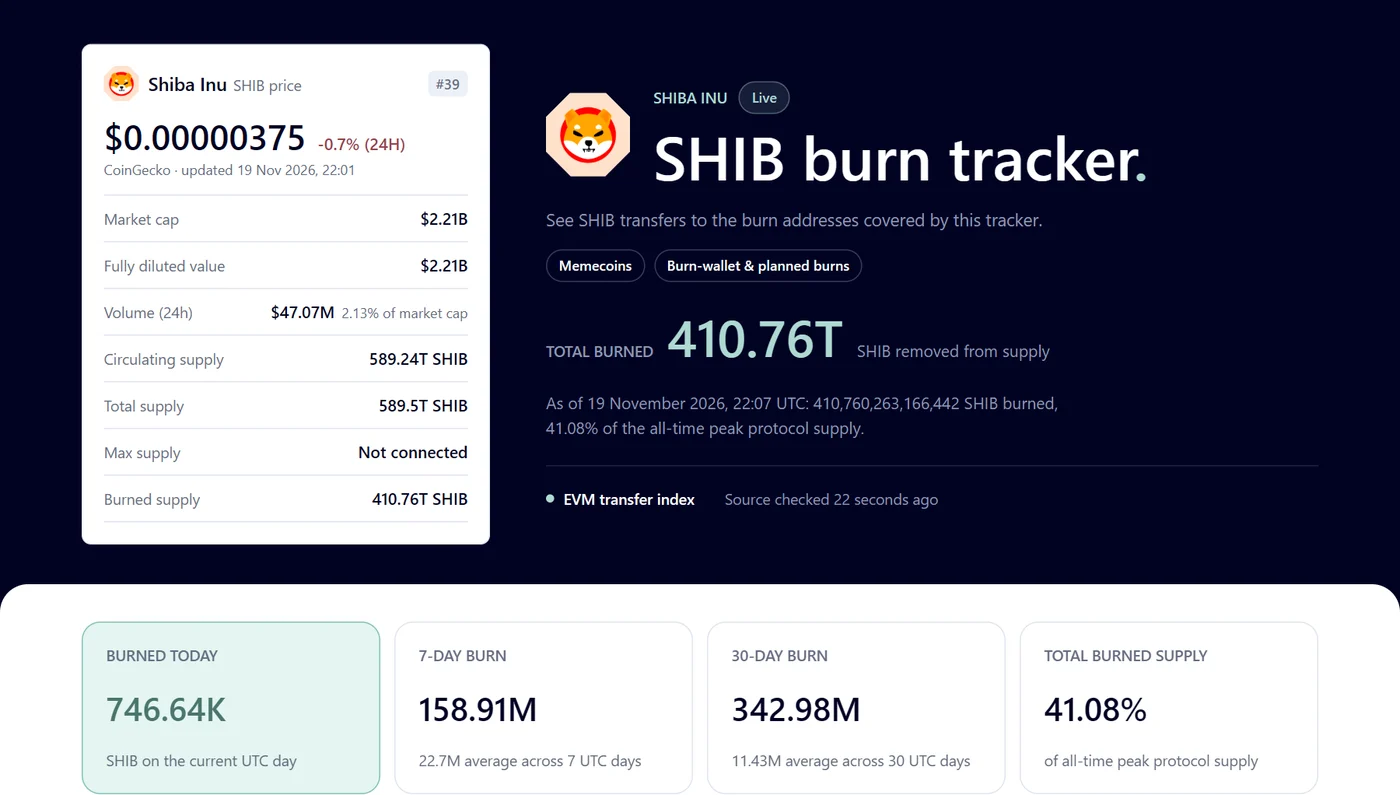
SHIB’s share is the biggest, but it reflects one day, not a habit. On 16 May 2021, Ethereum co-founder Vitalik Buterin sent about 410 trillion SHIB to a dead address. Everything else in the record comes to less than 0.2% of that.
PONS put a third of its supply there in four months, mostly with tokens bought on the market. In dollars, the biggest pile we track is BNB’s: around $10 billion at today’s price. But a big pile only records past decisions. It doesn’t say whether the burning goes on.
Does a big pile mean a steady burn?
Not necessarily, and UNI shows both kinds. In five years about 50,000 UNI had reached Ethereum’s dead address, sent by people on purpose or by mistake; nobody can tell which. Then, on 27 December 2025, a governance vote sent 100 million at once.
For anyone holding UNI, what came next matters more. Burns paid for by Uniswap’s protocol fees, plus whatever else people send, have added about 14 million since. No month this year has gone without some. The vote was one event; the trickle is still running.
When is a burn not really a burn?
When somebody can still undo it, or when new tokens quietly replace it.
A team’s “burn wallet”
PancakeSwap collects its unused CAKE emissions in a burn Safe that needs three of its seven owners to sign, then sends them to the dead address about once a week. ASTER’s team keeps its reserve in a multisig. Until tokens reach the dead address someone can still move them, so our CAKE and ASTER trackers don’t count them yet.
Tokens sent by mistake
Tokens sent to a token’s own contract are usually gone for good, but nobody chose to burn them; our UNI and ASTER trackers list them apart as “permanently locked”. Tokens sent to Solana’s incinerator are stuck the same way. And a burn counts only on its own chain: 0x…dEaD on BNB Chain is not 0x…dEaD on Ethereum.
A contract that can still mint
This is the big one. More than 5.5 billion CAKE has gone to burn addresses, many times more than has ever existed at once. Yet CAKE’s supply is only about 15% below its peak, because new CAKE is minted every week and most of each burn is that fresh CAKE.
A burn shrinks a supply only when more is destroyed than created.
How do you check a burn address?
Open it on a block explorer for its own chain and look for three things.
- It has never sent anything. One outgoing transaction, ever, means somebody holds the key.
- It holds no code. A contract can have a function that moves tokens out. If a burn address is a contract, find out why.
- The pattern is obvious. Anyone can find a key whose address starts with a few chosen characters, but not one for a whole string of zeros. A random-looking address that a project says has no key can’t be checked; the well-known ones are labelled by explorers.
What to watch next
Next time a project announces a burn, these tell you how much it means.
- A destination you can open. A burn with no address or transaction to check is a claim, not a burn.
- Where the tokens came from. Tokens bought on the market leave circulation. Tokens from a team reserve were never traded, so burning them shrinks what could be sold later, not what is on the market today.
- What is still being minted. If the contract can mint, set the burn against what was created over the same weeks.
How we counted
Our SHIB, CAKE, UNI, ASTER, PONS and BNB trackers add up what reaches a fixed, reviewed set of burn addresses on each coin’s own chain, and reconcile it with those addresses’ on-chain balances. SHIB’s set has four: the zero address, the standard dead address, the one Vitalik Buterin used, and the token contract.
The first chart divides the tokens at the dead address (for SHIB, all four) by the starting supply. On 19 November 2026: 410,760,263,166,442 SHIB of 1 quadrillion; 330,624,219 PONS and 114,293,581 UNI, each of 1 billion; 18,147,852.50 BNB of 200 million, at BNB Smart Chain’s dead address only; 216,176,678 ASTER of 8 billion. The CAKE tracker counts 5,524,705,772 CAKE sent to burn addresses or locked, and a net supply 14.52% below its peak of 392,073,933. The UNI chart ends at 114,253,581 UNI on 18 November 2026.
The ETH and Bitcoin balances are reads of 19 November 2026 from an Ethereum node and mempool.space. BNB’s dollar value is ours, at that day’s price of $576.13; a value at today’s price is not money anyone spent. Nothing here is a price forecast.
Check it yourself
- Open the dead address. 0x…dEaD on Etherscan lists years of transfers coming in and none going out.
- Open a Bitcoin eater address. The eater address on mempool.space shows everything it has received, and that none of it was ever spent.
- Compare with a tracker. The UNI tracker’s methodology names the three addresses it counts and how each is checked against its balance.
Every burn-address coin we track shows what reached its dead address, and when. Start with the Shiba Inu burn tracker.
Informational only, not financial advice.Sources
- BurnTracker: the SHIB, PONS, UNI, BNB, ASTER and CAKE trackers and their methodologies (totals, daily totals, burn addresses, the CAKE burn Safe and minting, the ASTER team multisig), read on 19 November 2026. Prices: CoinGecko, in BurnTracker’s market snapshot of the same day.
- Ethereum: Etherscan pages for 0x…dEaD and the SHIB dead wallet of May 2021; the ETH balance read over JSON-RPC from an Ethereum node at block 26,449,150. OpenZeppelin ERC20.sol (the _burn function and the zero address).
- Bitcoin: mempool.space for the eater address; the Bitcoin Wiki and the developer guide on OP_RETURN.
- Solana: the incinerator module in the Solana SDK; the SPL Token documentation (the Burn instruction); Sol Incinerator docs on tokens sent to the address.