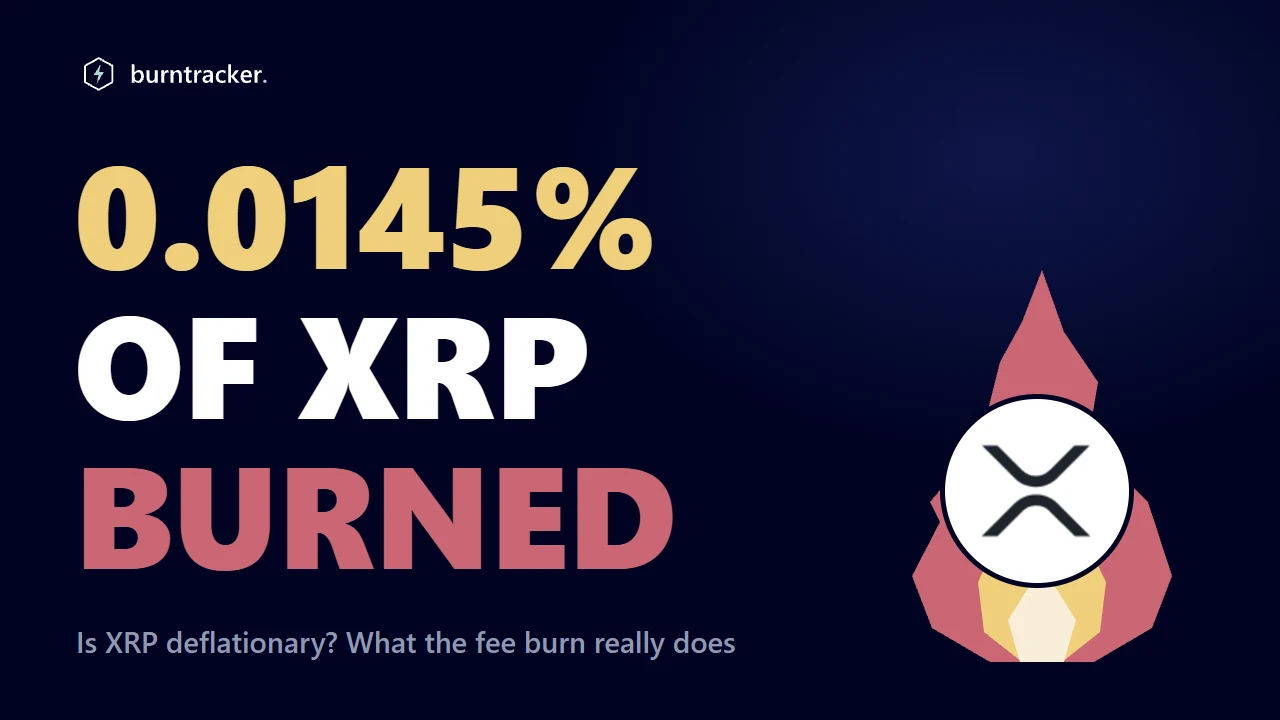
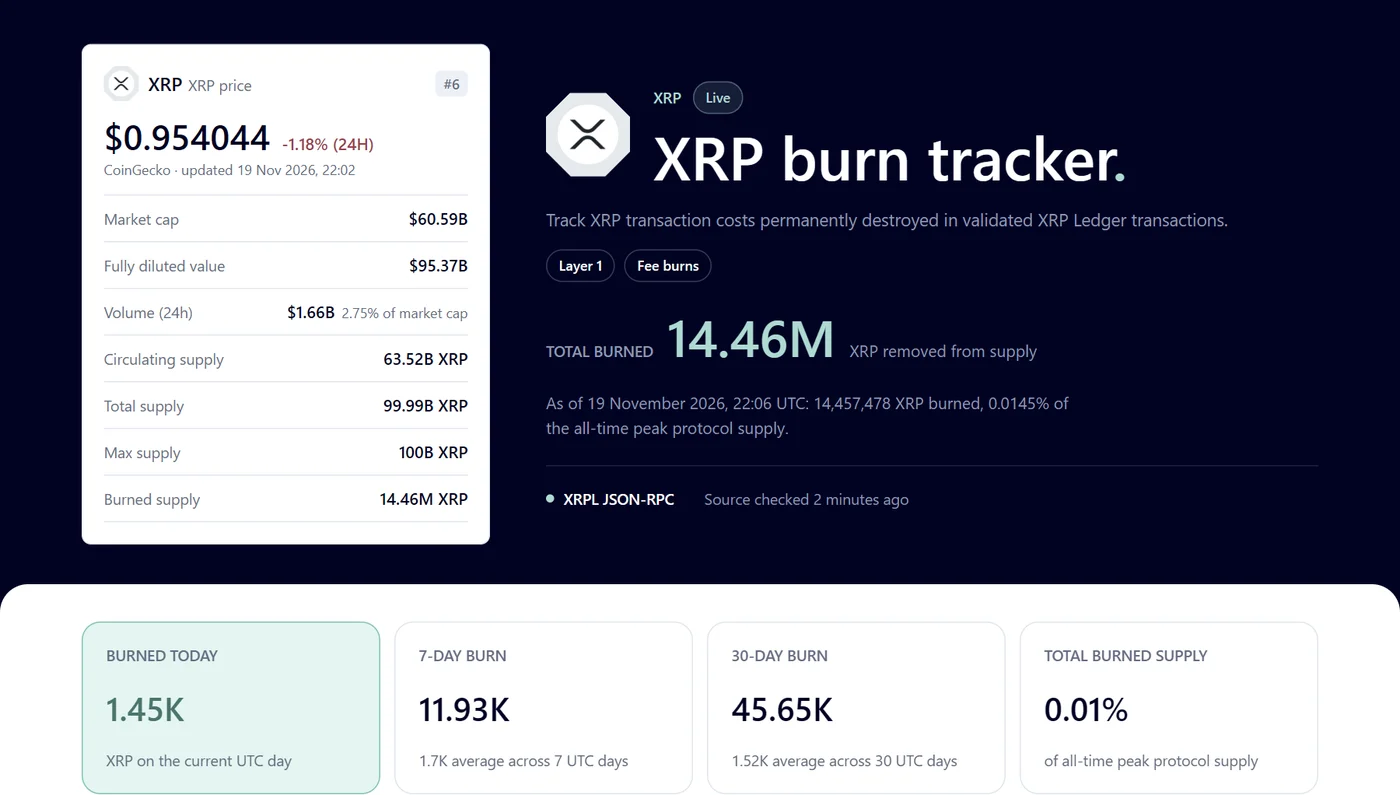
XRP’s supply only ever goes one way. Every transaction on the XRP Ledger destroys a small fee and no new XRP can be created, so the strict answer to “is XRP deflationary?” is yes. The catch is the size: the XRP burn tracker counts about 14.5 million XRP burned in the ledger’s whole history. Next to the 100 billion that were created, that hardly registers. And when the daily burn rate suddenly jumps, the reason is usually less exciting than it looks.
How is XRP burned?
There’s no burn address and no buyback. The burn is built into every transaction: to put anything on the ledger, the sender has to destroy a little XRP. The ledger’s documentation is blunt: “The transaction cost is not paid to any party: the XRP is irrevocably destroyed.”
The amount is tiny on purpose. The standard minimum is 10 drops. A drop is a millionth of an XRP, so that’s a small fraction of a cent.
The fee isn’t there to shrink the supply. The XRP Ledger docs say it protects the network from spam and denial-of-service attacks: one transaction costs nothing worth noticing, but millions sent to clog the ledger add up. When the ledger is busy, the fee needed to get in quickly rises too.
So the burn is really a meter of how much the ledger is used. 2017 alone accounts for about a quarter of all the XRP ever burned.
Is XRP deflationary?
Strictly, yes. There are fewer XRP today than yesterday, and there will be fewer tomorrow. But “deflationary” usually suggests a supply shrinking fast enough to matter, and XRP’s isn’t.
Everything burned so far comes to about 0.0145% of the original supply. This year the ledger has burned around 590 XRP on an average day. At that pace, by our arithmetic, burning a single percent of the supply would take some 4,700 years.
XRP’s supply really does shrink with every ledger. But the burn is a cost of using the network, not a plan to make XRP scarce.
Why does the XRP burn rate spike?
Because the daily total is millions of tiny fees added up, and one oversized fee can outweigh them all. On 2 October 2026 the tracker’s daily burn jumped to more than 8,000 XRP. The day before, it had been about 630.
The network wasn’t congested; the other transactions in those ledgers paid ordinary tiny fees. Most of the spike was a single payment: someone sent 700 XRP and set the fee at ten times that. That one fee was about 85% of the day’s burn. Two more payments from other accounts did the same on a smaller scale, one that morning and one on 5 October.
The ledger burns exactly the fee a transaction is signed with, even when that’s millions of times what the network asks. Who sent these payments, and why the fees were so high, the ledger doesn’t say, and we don’t know.
Take those fees out and October looks ordinary. The bigger change came after it: from around 20 October the daily burn rose to about 1,500 XRP and stayed there. That’s close to three times September’s pace.
No single fee is behind this one; the largest ledger in November burned only about 150 XRP. When we read the ledger on 18 November, it was handling about 70% more transactions a day than in September, each paying a little more on average. The daily totals can’t say whether that’s busy traffic pushing fees up, costlier transaction types such as account deletions, or senders choosing to pay extra.
That’s the difference worth knowing. A spike from one fee is noise, gone the next day. A rise spread across millions of transactions means the ledger is busier or more expensive to use. Even so, by our arithmetic a whole year at November’s pace would burn around 630,000 XRP. That’s less than a thousandth of one percent of the supply.
What moves the XRP in circulation?
Not the burn. The big lever is Ripple’s escrow. In December 2017 Ripple locked 55 billion XRP in escrow on the ledger. One billion unlocks at the start of every month, and Ripple said it would put whatever it doesn’t use back into a new escrow.
Escrowed XRP still exists; it just can’t be spent or burned until it unlocks. A release doesn’t change the total supply. It changes how much XRP Ripple can use, and that dwarfs the burn: one month’s release is about 69 times everything the ledger has ever burned.
Ripple’s own XRP page put the XRP still in escrow at about 31.7 billion at the end of September 2026. By our subtraction, that’s roughly 23 billion fewer than in 2017. Neither that page nor Ripple’s escrow announcement mentions burning escrowed XRP, and the supply record shows no such burn.
For how much XRP can reach the market, the escrow matters far more than the burn.
What to watch next
- Whether the late-October rise holds. A daily burn well above September’s pace of roughly 540 XRP means a busier or pricier ledger. A drop back means it was a passing wave.
- The next big spike. Before reading anything into a jump, check the tracker’s largest ledgers. If one ledger explains it, it’s one transaction.
- A change to the minimum fee. Validators can vote to change it, which would change what every transaction burns.
- Ripple’s escrow. Ripple’s XRP page reports how much it holds. That, not the burn, shows how much XRP is still locked away.
How we counted
Each XRP ledger records how much XRP exists, in a field called total_coins. The tracker counts the burn as the fall in that figure from one validated ledger to the next; a rise is rejected, never counted as a negative burn. Days before 13 July 2026 are stored as daily totals, later ones ledger by ledger. Coverage starts on 1 January 2013; the first 32,569 ledgers can’t be recovered and account for 0.003680 XRP, included in the first day.
As of 19 November 2026: 14,457,471.02 XRP burned, 0.01446% of the 100 billion created, and 586.6 XRP a day on average in 2026 to 18 November. October 2026: 30,634.02 XRP, of which 8,930 came from five oversized fees (7,000, 1,200 and 700 XRP, plus 20 and 10 XRP paid shortly before by two of the same accounts). 1 to 18 November: 31,057 XRP.
The payments, the other fees in their ledgers and the transaction counts were read from Ripple’s public full-history server on 18 November 2026. The cent comparison uses today’s price, about $0.95. Nothing here is a price forecast.
Check it yourself
- Open the 7,000 XRP fee. On the XRPL explorer, the payment of 2 October 2026 shows 700 XRP sent with a fee of 7,000 XRP.
- Read the supply yourself. Ask a public XRP Ledger server for a validated ledger with the ledger method. 100 billion XRP minus its total_coins (given in drops) is everything burned so far.
- Compare with the tracker. The XRP tracker lists daily totals and the largest ledgers, and its methodology explains the count.
- Check the escrow. Ripple’s XRP page reports how much XRP it holds in escrow.
Every day’s XRP burn, and the largest ledgers behind it, are on the XRP burn tracker.
Informational only, not financial advice.Sources
- BurnTracker: the XRP tracker (total, daily totals from 1 January 2013, the largest ledgers since 13 July 2026) and its methodology, read on 19 November 2026. Price: CoinGecko, in BurnTracker’s market snapshot of the same day ($0.95).
- XRP Ledger records, read on 18 November 2026 from Ripple’s public full-history server (s2.ripple.com): ledgers 107377383, 107384078, 107457180 and 107858384 (a ledger of account deletions on 23 October), and the 7,000 XRP payment.
- XRP Ledger documentation, xrpl.org: Transaction cost (destroyed fees, the spam purpose, the 10-drop minimum, the Fee field, the rising cost under load), rechecked on 19 November 2026; Fee voting; Ledger header (total_coins); Escrow; XRP overview (100 billion XRP, none can be created).
- Ripple: Ripple escrows 55 billion XRP for supply predictability, 8 December 2017; ripple.com/xrp, XRP held in escrow as of 30 September 2026.