In December 2025, Uniswap burned a tenth of all UNI in a single transaction. The tokens came from the protocol’s own treasury, on the orders of a governance vote called UNIfication. That burn was a one-off. The same vote also turned on Uniswap’s fee switch, and that part hasn’t stopped: it has burned about 14 million more UNI since, and the UNI burn tracker adds to the count many times a day.
What did the UNIfication vote burn?
It burned 100 million UNI that belonged to Uniswap’s governance: the treasury that UNI holders control by voting. Uniswap Labs and the Uniswap Foundation proposed it together in November 2025. Holders approved it almost unanimously in late December, and on 27 December the treasury sent the tokens to a dead address, one nobody can ever spend from.
Why that amount? The proposal calls it a retroactive burn, its estimate of “what might have been burned” had the fee switch been on since UNI launched in 2020. It doesn’t show the calculation. The figure is exactly a tenth of the supply created at launch, which looks more like a round number than a result.
Did it take UNI off the market?
No, and that’s the first thing to understand about it. Treasury tokens aren’t in anyone’s wallet or on any exchange. They sit in a governance contract and move only when holders vote to spend them. Before the burn the treasury held about 370 million UNI. Afterwards it still held about 270 million.
So the burn didn’t remove a single token that was for sale that day. What it removed was spending power: UNI that governance can never hand out in grants, budgets or incentives. That still matters to a holder, because treasury spending is one of the ways UNI reaches the market. But it’s a cut to future supply, not to today’s.
It also dwarfs everything around it. Before it, UNI had barely seen a burn in five years. Everything the fee switch has burned since comes to about a seventh of it.
How does the fee switch burn UNI?
By making a burn the price of collecting Uniswap’s fees. Uniswap doesn’t buy UNI with its revenue. Its share of trading fees piles up in a contract, in whatever tokens people traded, and anyone who wants that pile must first burn a fixed lot of their own UNI.
On Ethereum the lot is 4,000 UNI. On most of the other chains that later votes added, such as Base and Arbitrum, it’s 2,000. At today’s price, the Ethereum lot is worth just under $20,000. So the pile gets collected as soon as it’s worth a little more than that, and automated traders race to be first.
Nobody is appointed to do it; it happens because it pays. That ties the burn to trading: the more fees Uniswap’s pools earn, the faster the pile refills and the more often someone burns a lot.
How much does the fee switch burn?
About 1.2 million UNI a month, at the pace of the past month. Since it started, the average is a little higher, around 1.3 million a month, because the summer was busier than the autumn.
The burn started slowly and grew once other chains joined in March. It peaked in September, when the fee switch burned about 2.5 million UNI in a month. Then it fell back to roughly half that, and has stayed there through October and November.
Most of September’s peak came from the other chains: their smaller lots made up about four fifths of it. Since July, chains other than Ethereum have supplied most of the burned UNI every month. Why September jumped, we can’t tell: the tracker sees the burns, not the trading behind them.
Over a full year, this autumn’s pace would come to about 15 million UNI. That’s roughly 1.5% of all the UNI ever created. And at that pace it would take more than six years to burn as much as the one vote in December did. Those are our projections from the tracker’s numbers, not anything Uniswap has promised.
What does it mean for someone holding UNI?
The two burns are different things. The December burn was a decision about tokens that weren’t on the market. The fee burn uses tokens that were: every lot is UNI the collector brought along and destroyed.
That makes the fee burn the part tied to how much Uniswap is used. More trading means more fees, faster refills and more lots burned. There’s a twist, though. The lot is fixed in UNI, while the fees arrive in other tokens, such as dollar stablecoins and ether. When UNI’s price falls, the same fees pay for more lots, so the burn counted in UNI goes up. A rising UNI burn doesn’t by itself mean busier pools.
It also helps to set the burn against what leaves the treasury. The same vote set aside 20 million UNI a year from the treasury to pay for growth, and that is spent, not burned. At its current pace, the fee burn is a little smaller than that budget. If all of the budget were sold, the burn wouldn’t quite cover it; nobody outside can say how much will be.
The 100 million was a one-time cut to what the treasury can spend. The burn that keeps going is the fee switch, and it rises and falls with Uniswap’s fees and UNI’s price.
What to watch next
- The monthly pace. Since September’s peak, the fee burn has settled at around 1.2 million UNI a month. A climb back would mean more fees, a lower UNI price, or both.
- The lot size and new chains. Governance can change the size of a lot, and it has already added chains twice. Either would show in the burn rate within days.
- Treasury spending and minting. The growth budget leaves the treasury every year, and governance may mint up to 2% of the supply a year. None has been minted so far; the tracker checks the supply on every update.
- Another one-off. A second treasury burn would need a new vote, and would show on the tracker as one huge transfer.
How we counted
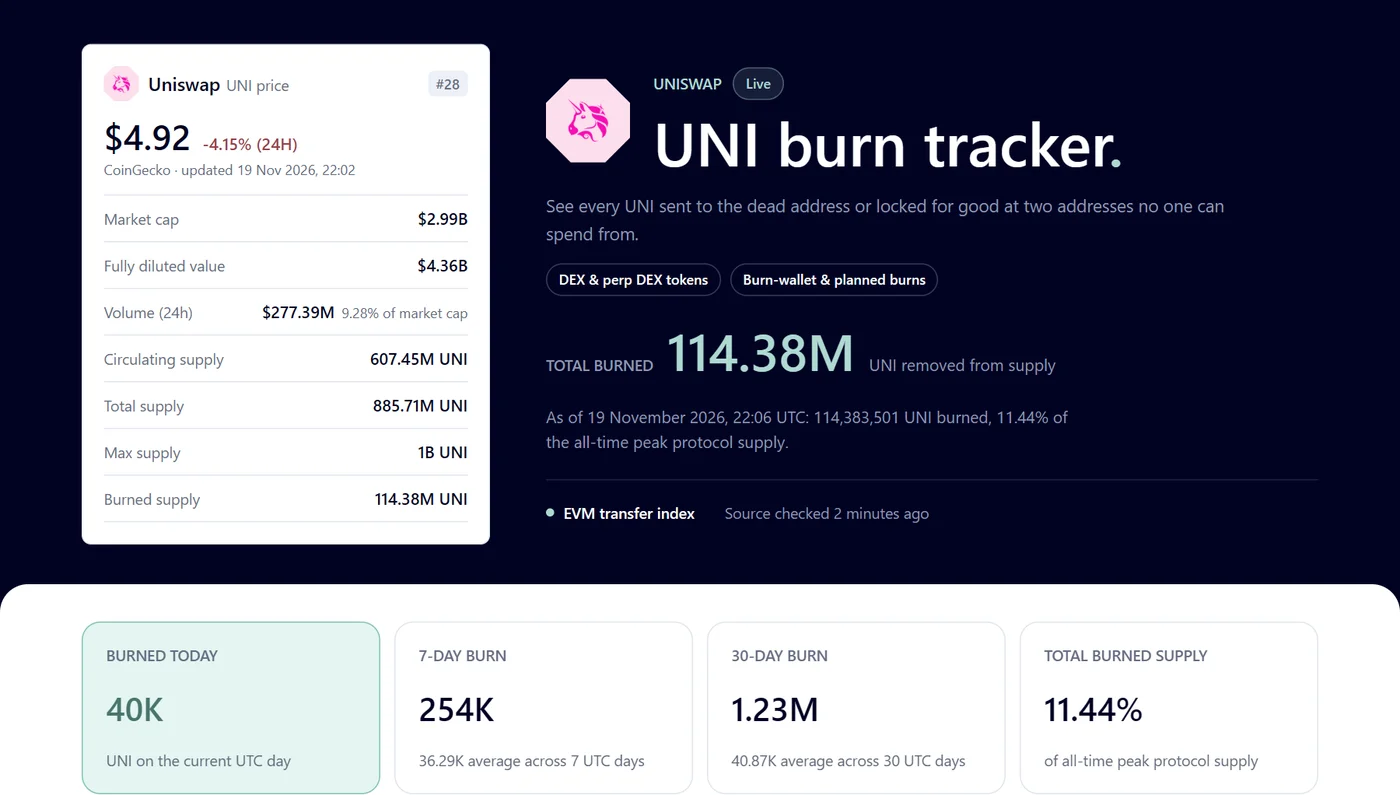
The UNI contract has no burn function, so a UNI burn is a transfer to an address nobody can spend from. The tracker adds up every finalized transfer on Ethereum since UNI’s launch into three addresses: the dead address, shown as Burned, and the UNI contract itself and the address 0x…0001, shown as Permanently locked. As read at 21:45 UTC on 19 November 2026, that’s 114,383,501 UNI: 114,293,581 burned and 89,920 locked.
The comparisons run to 18 November 2026, the last complete UTC day. The UNIfication burn is 100,000,000 UNI; 138,394.70 UNI were burned or locked before it; and 14,204,004.59 UNI reached the dead address in the 325 days from 29 December 2025, including 25 small transfers of 4.59 UNI together that weren’t fee burns. Uniswap’s vote page dates the execution 29 December; the block that holds the transaction is timestamped 27 December, and the tracker uses the block. Burns from other chains count when their UNI reaches the dead address on Ethereum, which for chains such as Base is about a week after the release.
The UNI contract still reports a total supply of one billion, because burned tokens stay in its accounting; CoinGecko subtracts them and shows 885,710,418 UNI. Dollar figures use CoinGecko’s price of $4.93 and are not what anyone paid. The monthly and yearly paces are our own arithmetic from the tracker’s daily totals. Nothing here is a price forecast.
Check it yourself
- Open the one-off. The transaction of 27 December 2025 shows one transfer of 100,000,000 UNI from the Timelock, the treasury’s contract, to the dead address.
- Read the lot size. On the Firepit contract, choose “Read Contract” and call threshold. It returns 4000 followed by 18 zeros, because UNI has 18 decimal places.
- Compare with the tracker. The dead address’s UNI balance should match the Burned line on the UNI tracker, which lists every burn with its transaction. Its methodology names the three addresses that count.
Every fee burn, 4,000 or 2,000 UNI at a time, lands on the Uniswap burn tracker as it reaches Ethereum.
Informational only, not financial advice.Sources
- BurnTracker: the UNI tracker (total, daily totals, latest and largest burns) and its methodology, read on 19 November 2026. Price and total supply: CoinGecko, in BurnTracker’s market snapshot of the same day ($4.93; 885,710,418 UNI).
- The proposal: UNIfication Proposal, Uniswap governance forum, 10 November 2025; the same text on the Uniswap Labs blog; the vote page for proposal 93.
- The chains added later: the vote pages for proposal 94 and proposal 95; the forum thread Protocol Fee Expansion: Three More Chains, executed as proposal 96.
- How the fee burn works: Uniswap’s protocol fee documentation, overview and deployed contracts; the protocol-fees repository.
- Ethereum records, read from the chain for the first version of this article on 18 November 2026: the burn transaction, the treasury’s UNI balance before and after it, the vote on proposal 93, the Firepit’s threshold, and the size of each fee burn by month. UNI’s minting rule: the token’s source, Uni.sol.