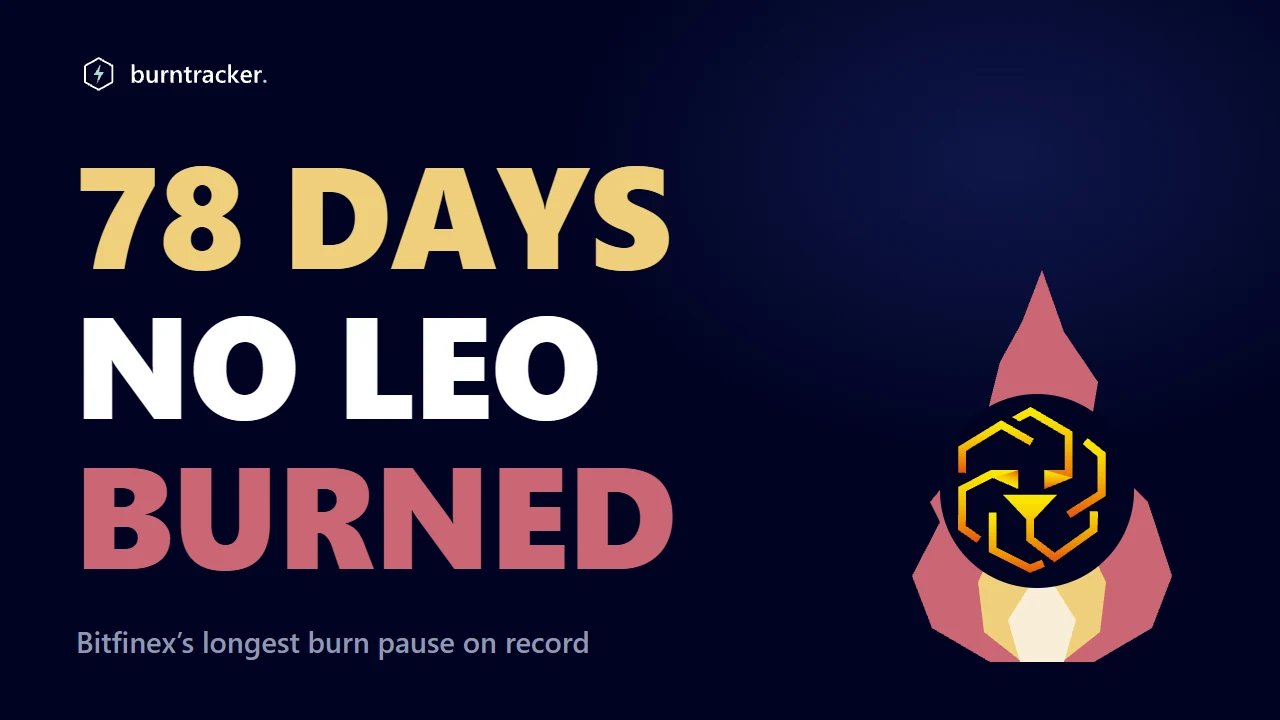
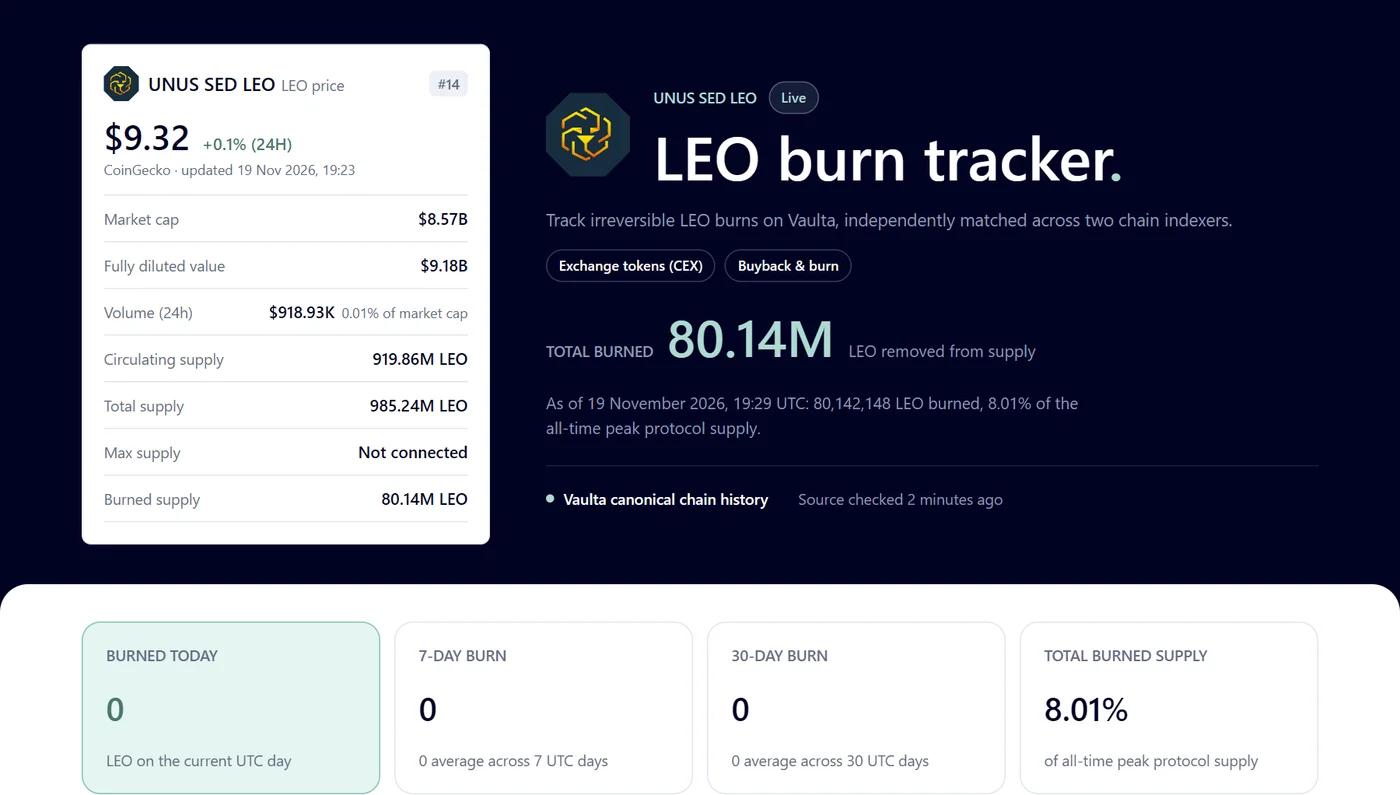
For most of seven years, you could set a clock by it. Bitfinex bought LEO on the market and burned it: every three hours at first, later once a day. On 1 September 2026 it stopped. As of 19 November 2026, the LEO burn tracker has gone 78 full days without a single burn, the longest silence since the burns began in 2019. Bitfinex hasn’t said why.
What happened
The last burn was small and ordinary: 6,559 LEO, at three in the morning UTC on 1 September. Nothing about it looked like a goodbye. The next morning there was no burn, and there hasn’t been one since.
That matters because the burn is the public half of a promise. When iFinex, the company behind Bitfinex, sold one billion LEO in 2019, it committed to spend at least 27% of its revenue every month buying LEO back, until none is left in circulation. Burning the tokens on the blockchain is how anyone outside the company can see that promise being kept.
Has Bitfinex stopped buying LEO?
Probably not, and this is the most useful thing to understand about the pause. Buying and burning are two separate steps. Bitfinex buys LEO on its own exchange, where nobody outside can watch. Only the burn happens on the blockchain, where everyone can.
When we last compared the two, in late September, Bitfinex’s own LEO page showed that the buying had carried on and that the LEO it bought was waiting to be burned. So the likeliest explanation is a backlog, not a broken promise.
But a backlog nobody can verify is exactly what the burn was meant to rule out. For as long as the pause lasts, LEO holders are taking Bitfinex’s word for it.
Has this happened before?
Yes, six times, though never for this long. And the earlier pauses ended in one of two ways.
Four of them ended with one oversized burn that made up for the missed days almost exactly. After 59 days of nothing in the summer of 2025, Bitfinex burned about 385,000 LEO in a single day: roughly sixty normal days’ worth. After 27 days in early 2026, it burned about 229,000. The buying had evidently never stopped. Only the burning had been saved up.
The other two, short pauses of eight and five days, ended with an ordinary small burn. Those missed days were never made up.
If this pause ends the way the long ones did, the first burn back will be a big one: around half a million LEO in one go.
That number is our own estimate, not Bitfinex’s: 78 days at August’s pace of about 6,900 LEO a day.
Does the pause change LEO’s supply?
Hardly. And that’s the part most talk about LEO burns misses: the burn has been shrinking for years.
In 2021, Bitfinex burned more than 32 million LEO. This year it has burned less than 2 million. The promise didn’t change. The price did. The buyback is a share of revenue, counted in dollars, and LEO was sold at $1 in 2019 and trades at about $9.30 today. The same dollar now takes roughly a ninth as many tokens off the market.
So even at full speed, the burn barely moves the supply any more. The 78 missing days come to about half a million LEO, or 0.05% of the one billion issued. At August’s pace, burning the 920 million LEO still out there would take more than 350 years.
That’s the real story of the pause. It isn’t that LEO’s supply stops falling; it was barely falling anyway. It’s that the daily burn was the one part of the buyback anyone could check for themselves, and for eleven weeks there has been nothing to check.
What to watch next
- One very large burn. Around half a million LEO in a day would mean the backlog is being cleared, as it was in 2025 and early 2026. It would be one of the biggest burn days on record, and it would show on the tracker within minutes.
- Small daily burns starting again, with no catch-up. That’s how the two short pauses ended. After 78 days it would leave an open question: what happened to the LEO bought in between?
- A word from Bitfinex. We found no statement about the pause in September, and none on 19 November 2026.
How we counted
A LEO burn is a transfer of LEO to the token’s own contract account on Vaulta, the blockchain formerly called EOS, marked with the memo burn. The tracker counts each one once it is final on the chain, and accepts a new burn only when two independent history services agree on it. The record is complete from the first burn on 14 June 2019: 17,578 burns, 80,142,148 LEO.
LEO that Bitfinex has bought but not yet burned isn’t in that total, and we don’t republish Bitfinex’s own figures; they are on leo.bitfinex.com. Dollar comparisons use the latest price, not what Bitfinex paid. Nothing here is a price forecast.
Check it yourself
- Open the last burn. The transaction of 1 September 2026 shows 6,559 LEO going from bitfinexdep1 to bitfinexleo1 with the memo burn.
- See whether anything has come since. The newest transfers to the contract account are listed newest first. While the pause lasts, the 1 September burn is at the top.
- Compare with the tracker. The LEO tracker lists every burn with its transaction, and its methodology says what counts.
If Bitfinex burns again, it will be on the LEO burn tracker first. Until then, the counter stays where it stopped on 1 September.
Informational only, not financial advice.Sources
- BurnTracker: the LEO tracker (total, daily totals, latest and largest burns) and its methodology, read on 19 November 2026. Price: CoinGecko, in BurnTracker’s market snapshot of the same day ($9.32).
- Vaulta chain history, PayCash’s Hyperion service: the burn of 1 September 2026 and the latest transfers to the contract account.
- The buyback promise and the $1 sale price: iFinex, Initial Exchange Offering of LEO Tokens (the LEO white paper), 8 May 2019.
- The every-three-hours rhythm of 2019: The Block, Bitfinex launches real-time transparency initiative for its exchange token LEO, 14 June 2019.
- BurnTracker’s research note of 27 September 2026 (the comparison with Bitfinex’s own page, and the search for a statement). Bitfinex’s LEO page: leo.bitfinex.com. No figure in this article is taken from it.