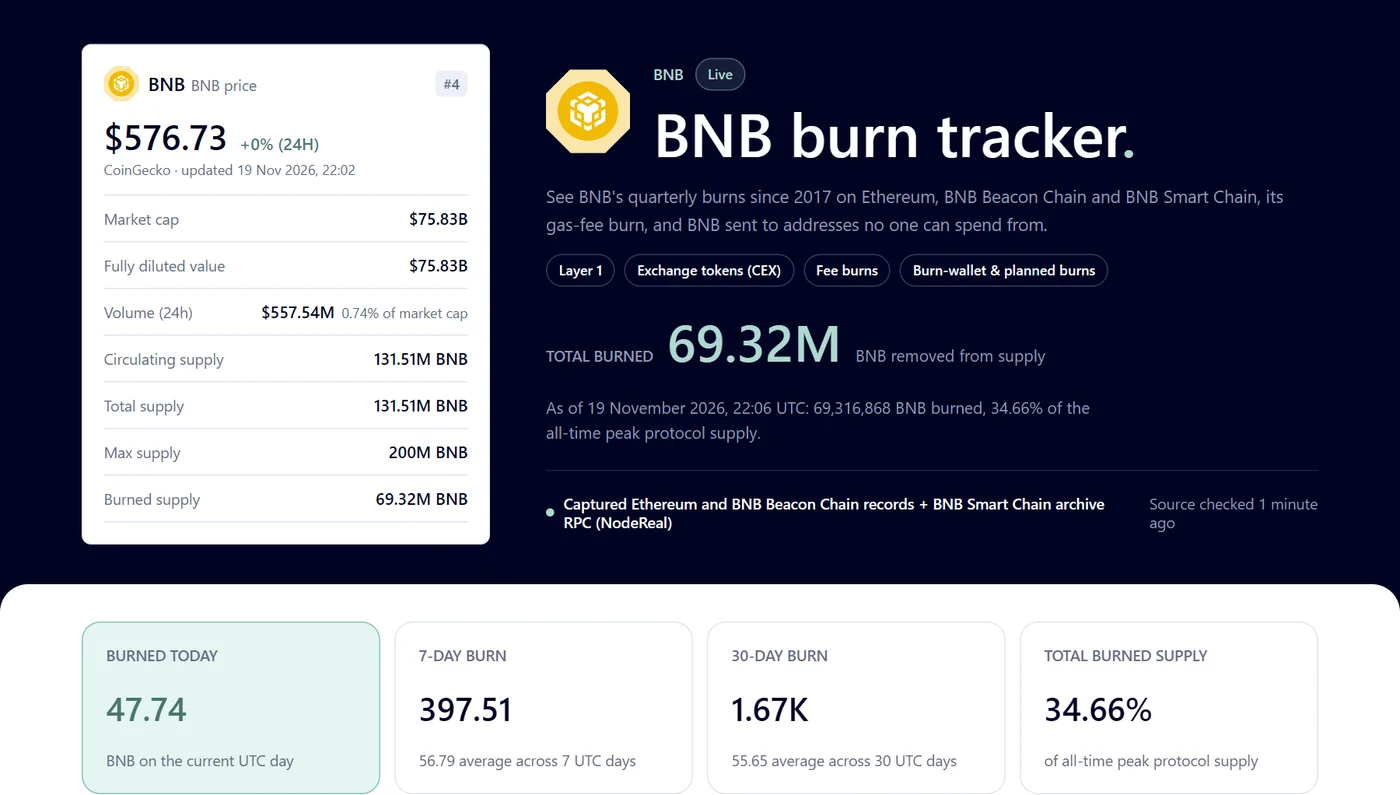
Every three months, BNB Chain sends more than a million BNB to an address nobody can spend from. No one decides the amount: a formula does, and it has a twist most holders don’t expect. The more BNB costs, the fewer BNB it burns. The BNB burn tracker counts about 69.3 million burned so far. The target is 100 million.
How does Auto-Burn set the amount?
With a formula anyone can redo. Since January 2022, every quarterly burn has been sized by Binance’s Auto-Burn rule, from two inputs: how many blocks BNB Smart Chain produced in the quarter, and BNB’s median price over it.
The block count is really a clock. The chain now makes blocks far faster than when the rule was written, so they are counted at the old pace of one every three seconds: about 2.6 million a quarter. That leaves the price as the one input that really moves.
Binance’s aim was a burn anyone can recompute, no longer tied to its revenue. The first 17 burns, before Auto-Burn, followed Binance’s own results.
Why does a higher price mean a smaller burn?
Because the price sits underneath the line. The formula divides a fixed amount, set by the block count, by BNB’s median price plus $1,000. A higher price makes the divisor bigger, so fewer BNB are burned.
The $1,000 anchor softens the effect: doubling the price cuts the burn by about a quarter, not by half. In dollars, the burn still grows when BNB gets dearer, just more slowly than the price.
Take July to September 2026. At a median price of $500, the formula would burn about 1.77 million BNB, worth about $883 million. At $1,000, it would burn about 1.32 million, worth about $1.32 billion. The real median was about $609, and the real burn 1,646,196.44 BNB.
There’s a ceiling too: even at a price near zero, a quarter’s burn can’t exceed the block count, about 2.65 million BNB. So the burn is predictable but not fixed. You know the rule in advance, and the amount only once the quarter’s price is in.
How has the quarterly burn changed?
It has become steadier, and lately smaller. The first 17 burns swung with Binance’s results. The biggest of all, about 3.6 million BNB, came in January 2021.
Since Auto-Burn, every burn has landed between about 1.4 and 2.1 million BNB. With the block count nearly constant, the line is roughly BNB’s price turned upside down. The biggest Auto-Burns measured the second half of 2023, when BNB was cheapest; the smallest measured the end of 2025, when it was dearest.
The latest, in October, was about 1.65 million BNB, the third rise in a row. BNB Chain valued it at about $1.2 billion on the day. The rise doesn’t mean the burn got more generous, only that BNB’s median price over the summer was lower than at the end of 2025.
What about the burn in every block?
It’s real but small. Since November 2021, a rule called BEP-95 has sent a tenth of the fees in every BNB Smart Chain block to the same dead address. On the tracker, the line that holds it has added about 66 BNB a day this year. Over a quarter, that’s roughly one BNB for every 250 the quarterly burn removes.
So it’s the quarterly burn that moves the supply. The fee burn matters for another reason: BNB Chain says it keeps going after the quarterly burns stop.
How far is BNB from 100 million?
About 31.5 million BNB, by BNB Chain’s own count. Its post for burn #37 put the remaining supply at about 131.5 million. The target is to leave half of all the BNB ever created.
The last four burns removed about 6.2 million BNB in a year. At that pace, the rest would take around five years. That’s our own division, not a schedule: every burn depends on a price nobody knows in advance, and the higher BNB goes, the longer it takes. Even at the formula’s maximum, it would need about three years.
Binance’s announcement says Auto-Burn stops once the BNB in circulation falls below 100 million.
What does it mean for BNB holders?
The supply is shrinking by a rule you can check: at the recent pace, by a little under 5% of what’s left each year. Binance’s profits no longer play a part.
And the rule leans against the price. When BNB is expensive, fewer coins go; when it’s cheap, more. That’s the opposite of what many people expect from a burn, and a good reason not to read a big burn as a signal about the price.
BNB’s quarterly burn is arithmetic on two public numbers, and it takes fewer coins when BNB is dearer. The 100 million mark is years away, not quarters.
What to watch next
- Burn #38 in the new year. It measures October to December, so its inputs are final on 31 December. Each of the last eight burns came within four weeks of its quarter’s end.
- A vote on the anchor. K can only change through a BNB Chain proposal and a community vote. A lower anchor would mean bigger burns at any price; a higher one, smaller.
- How the blocks are counted. BNB Chain’s burn posts since mid-2025 say only that the parameters were adjusted for faster blocks. A different conversion would change every burn after it.
How we counted
The tracker counts all 37 quarterly burns, on Ethereum (#1 to #7), BNB Beacon Chain (#8 to #26) and BNB Smart Chain (from #27, each a transfer to the dead address): 68,773,787.42 BNB. With the gas-fee line (443,792.81 BNB, which also holds BNB people send to the dead address themselves) and the zero address (99,246.95), the total was 69,316,868.04 BNB at 21:51 UTC on 19 November 2026.
Unlike BNB Chain, the tracker doesn’t count 146,252.71 BNB of Pioneer Burn Program credits, which no transaction destroyed. And 100 million minus the tracker’s total, 30,683,132 BNB, isn’t BNB Chain’s distance of 31,512,085: the tracker counts 97,043.93 BNB that the 2022 bridge exploit created, and BNB Chain’s supply figure sits above 200 million minus its own announced burns, which it doesn’t explain.
Our estimates: 31,512,085 ÷ 6,203,035.24 (burns #34 to #37) = 5.1 years; ÷ 10,519,200 (the formula’s yearly maximum) = 3.0 years. The fee-burn rate is the gas-fee line’s 21,144.80 BNB from 1 January to 18 November 2026. Dollar figures are BNB Chain’s value on the day and the example’s own prices, not money spent. Nothing here is a price forecast.
Check it yourself
- Open burn #37. On BscScan, the transaction of 19 October 2026 shows 1,646,196.441 BNB going to the dead address, 0x…dEaD.
- Redo the formula. The third quarter of 2026 had 17,655,618 blocks; times 3/20, rounded down, N = 2,648,342. With the median price on bnbburn.info, $608.76426: 2,648,342 × 1,000 ÷ 1,608.76426 = 1,646,196.44 BNB.
- Check the distance. BNB Chain’s post for the 37th burn gives the remaining supply as 131,512,085 BNB. Subtract 100 million.
- Compare with the record. The BNB tracker lists every quarterly burn with its transaction, and its methodology says what is counted on each chain.
Burn #38 will be on the BNB burn tracker as soon as it is on the chain. Until then, only the fee burn ticks over.
Informational only, not financial advice.Sources
- BurnTracker: the BNB tracker (total, the 37 quarterly burns, daily totals) and its methodology, read on 19 November 2026.
- The Auto-Burn rule: Binance, Introducing BNB Auto-Burn (21 December 2021), for the formula, N, P and K, its aim, and the halt below 100 million; bnbburn.info, read on 18 November 2026, for the block-count conversion and the inputs of the third quarter of 2026.
- BNB Chain’s burn announcements: 37th BNB Burn (19 October 2026), for the amount, its value on the day and the remaining supply; 36th BNB Burn (15 July 2026), for the supply after #36; 32nd BNB Burn (10 July 2025), on the adjustment for faster blocks.
- The 100 million target and the early burns from profits: BNB Chain, The Importance of Utility and the Role of Native Tokens (11 November 2022).
- The fee burn: BEP-95; BNB Chain, Introducing BEP-95 with a real-time burning mechanism (22 October 2021).