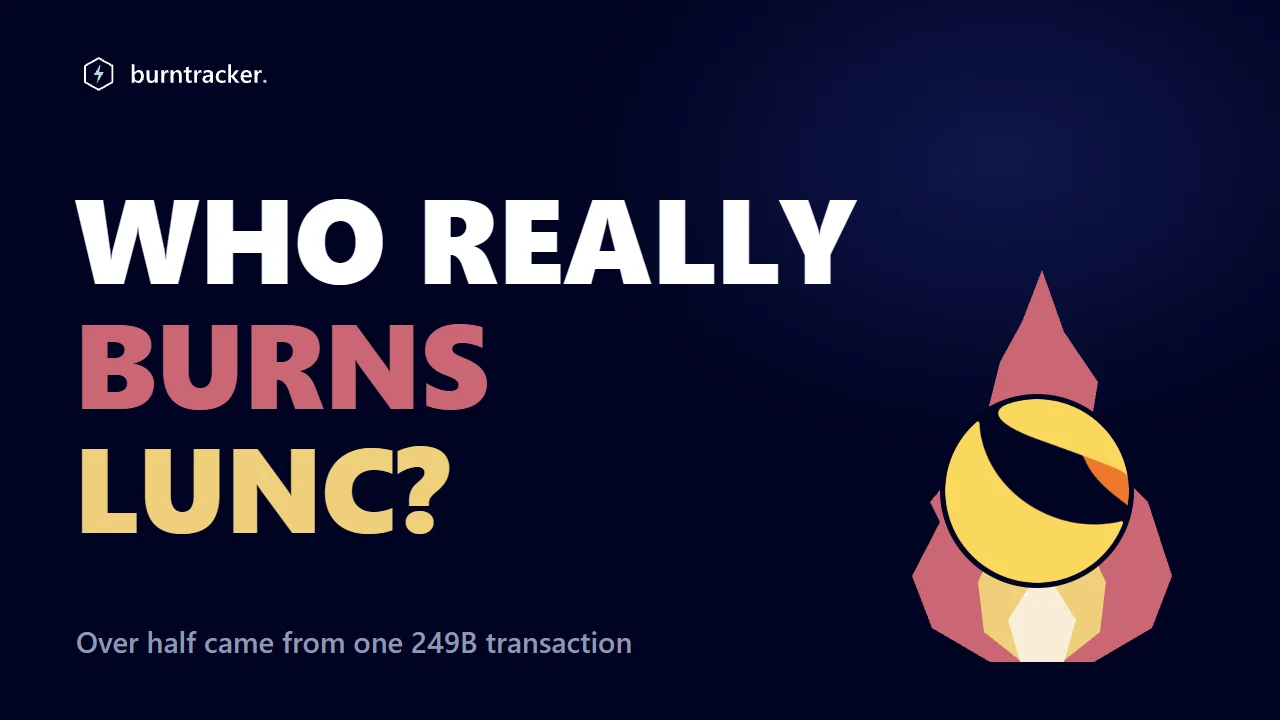
Ask who burns Luna Classic and most holders will say Binance. The chain tells a different story. More than half of all the LUNC burned since the 2022 collapse went in a single transaction, when a bankrupt company shut down a bridge. Today the Luna Classic burn tracker shows a burn carried almost entirely by the chain’s own tax, while Binance’s monthly batch keeps shrinking and, this November, hasn’t come at all.
Who has burned the most LUNC?
Not Binance, but a bridge that burned exactly once. Since LUNC’s supply peaked in May 2022, about 465 billion LUNC have been burned, in four very unequal parts.
The one transaction, on 4 November 2024, is about 249 billion LUNC on its own. Binance is a distant second, with roughly a fifth of the total. The tax bar is small partly because exact tax records only start in December 2024; earlier tax burns sit in “everything else”.
So the big total flatters the burn. Take the one transaction away, and everything burned since 2022 comes to about 3% of the peak supply.
Who sent the 249 billion?
Terraform Labs’ Shuttle bridge, as it was being wound down. Shuttle held LUNC on Terra Classic while wrapped copies circulated on other chains. In 2024 the court in Terraform Labs’ bankruptcy let it reopen so holders could bring their wrapped tokens home, and Terra said whatever was left afterwards would be burned.
The chain shows how that played out. In late August 2024 the bridge moved about 274 billion LUNC to a new wallet, which paid out about 23 billion to the people who came back. On 4 November that wallet sent the rest to the burn wallet, and the next day Terra announced the bridge closed for good.
No LUNC was bought for this burn. These coins were the backing for wrapped tokens nobody redeemed: a real cut in the supply, but a one-off, since a bridge can only close once.
That single transaction equals more than six and a half years of LUNC burning at today’s pace.
That comparison is our own arithmetic, from the average of the last 30 days.
How much does Binance burn now?
Less every year, and in November nothing so far. Binance adds up the trading fees on its LUNC pairs and burns the matching amount of LUNC on the first day of each month. Since December 2022 that has been half the fees rather than all of them.
The batches have shrunk sharply. In 2024 they averaged about 2 billion LUNC. The last three averaged around 300 million, and September’s and October’s were identical to the last decimal, an odd result for two different months of fees.
Then November broke the rhythm. A batch had arrived on the first of every month since April 2023, but by the evening of 19 November nothing had come from Binance’s address. DailyCoin reported on 13 November that Binance hadn’t commented, and we found no statement from Binance either.
For the supply, the gap is small: a recent batch is worth about three days of the burn tax. But if you think of the LUNC burn as Binance’s burn, the chain says the story has moved on.
Is the LUNC burn rate slowing?
Not overall. A typical month over the past two years has burned around 3 billion LUNC, and recent months are no different.
What changed is who pays. In 2025, Binance’s batches were about a fifth of the year’s burn. Since August 2026 nearly all of it is the tax, after a governance vote tripled the rate to 1.5% of each transaction.
The increase came in a slow patch. In the 30 days before the vote, about 42 million LUNC were burned a day. In the last 30 days it was about 103 million, close to 2025’s average.
So the burn now depends on how much LUNC moves on the chain, and on a rate that the next vote can change.
Can the burn ever dent 6.4 trillion LUNC?
Only slowly. About 6.44 trillion LUNC exist today, and the burn takes them out in fractions of a percent a year.
At today’s pace, burning 1% of LUNC’s supply takes about 21 months.
A tenth would take about 17 years. These are our own sums, not forecasts: the pace moves with activity on the chain, with the tax rate and with one-offs like the bridge.
Since the 2022 peak, all the burns together have removed under 7% of the supply, and more than half of that came on one day in November 2024. The steady burn is real, but small against the supply.
What to watch next
- Binance’s November batch. A transfer of a few hundred million LUNC from Binance’s address would show on the tracker the day it lands. A statement from Binance would say more.
- The tax rate. Almost all of today’s burn is the tax, so a vote to lower it would cut the burn with it.
- Activity on the chain. The tax burns a share of every transaction, so the daily burn follows how much LUNC moves.
How we counted
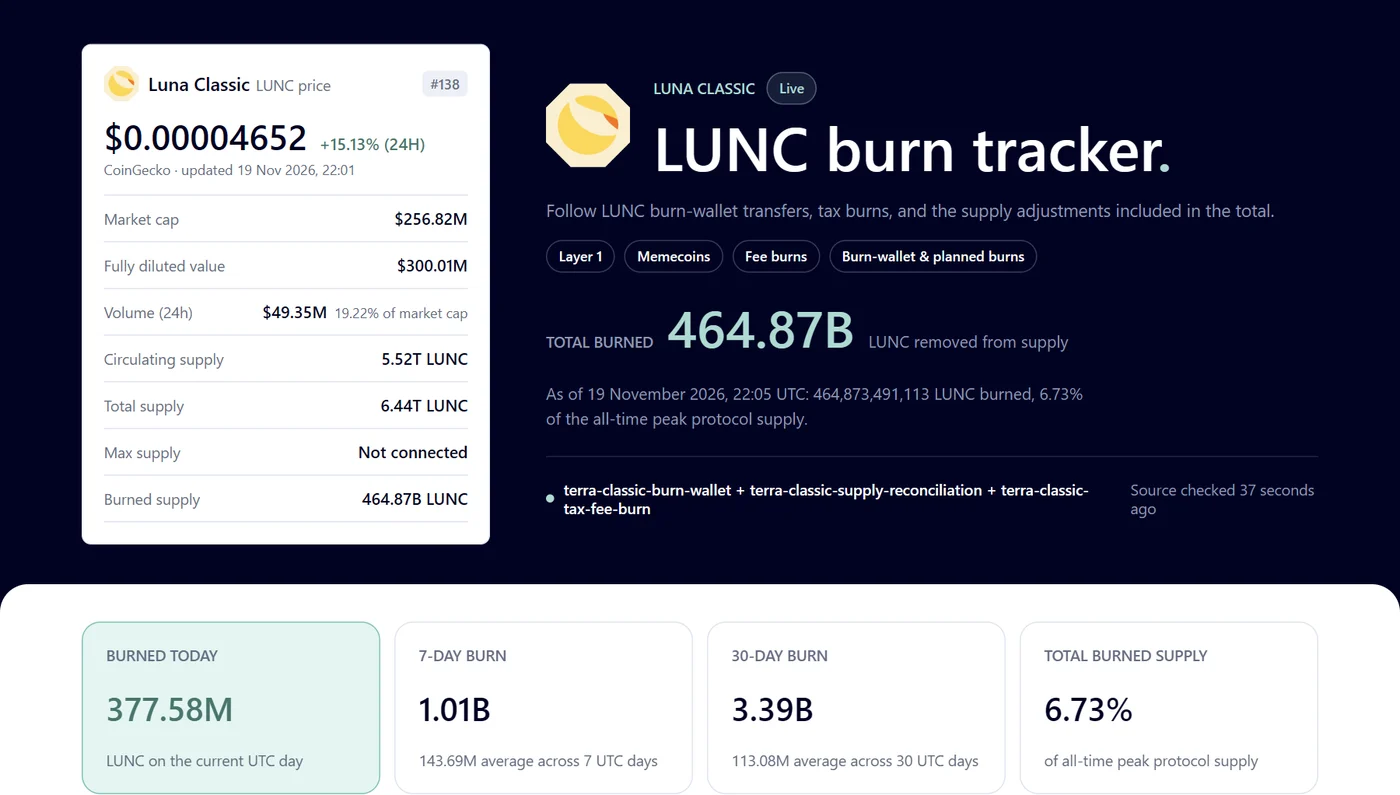
The tracker counts the Luna Classic burn as the fall in LUNC’s supply since its peak of 6,907,376,873,996.22 LUNC on 13 May 2022 (block 7,607,789). As of 19 November 2026 at 21:52 UTC that fall was 464,873,001,922.56 LUNC: direct transfers to the burn wallet (350,970,362,728), tax burns with exact records from 17 December 2024 (19,574,770,565) and a daily reconciliation amount for the rest of the fall (94,327,868,630).
In the first chart, the 2024 transaction is 249,101,750,914.62 LUNC and Binance’s 50 batches, October 2022 to October 2026, are 88,095,126,936.62 LUNC, identified by sender, date and size; “everything else” is 108,101,353,506.50 LUNC. The tax is 1.5% of a transaction, of which 1.2% is burned. The pace is the average of 20 October to 18 November 2026: 102,931,369 LUNC a day, 97.9% of it tax burns. Who is behind an address comes from Binance’s and Terra’s own announcements, not from the tracker. Nothing here is a price forecast.
Check it yourself
- Open the 2024 transaction. The transfer of 4 November 2024 on Terra Finder sends about 249.1 billion LUNC to the burn wallet, terra1sk0…73anxu. Its sender was funded by the Shuttle address.
- Look for Binance’s November batch. All 50 batches came from terra18vn…u24sqe. A new one would be a transfer to the burn wallet, normally on the first of the month.
- Compare with the tracker. The LUNC tracker lists the largest burns and each day’s total, and its methodology explains the three lines.
If Binance’s batch arrives, or the burn rate changes, it will show on the Luna Classic burn tracker first.
Informational only, not financial advice.Sources
- BurnTracker: the LUNC tracker (total, daily totals by line, latest and largest burns) and its methodology, read on 19 November 2026.
- Terra Classic chain records on Terra Finder, read on 18 November 2026: the burn of 4 November 2024, the transfer of 27 August 2024 from the Shuttle address, the sending address and its history, Binance’s address and the burn wallet.
- Terra Classic governance, on PublicNode’s public node: proposals 10983 and 11111 (minting part of each burn back, and the repeal that preceded Binance’s cut to half the fees), proposal 12223 (the tax at 1.5%) and the current tax rate.
- Binance: the announcement on burning LUNC trading fees, first published 26 September 2022, read in the Internet Archive copies of 27 September 2022, 28 December 2022 (the cut to 50%) and 19 May 2024 (Binance’s wallets and the IDs of batches 1 to 21).
- The Shuttle bridge: Terra’s announcements of 19 July 2024 (the court order), 28 August 2024 (the reopening and the planned burn) and 5 November 2024 (the closure, also on X), and Terraform Labs’ Shuttle documentation.
- The missing November batch: DailyCoin, 13 November 2026.